
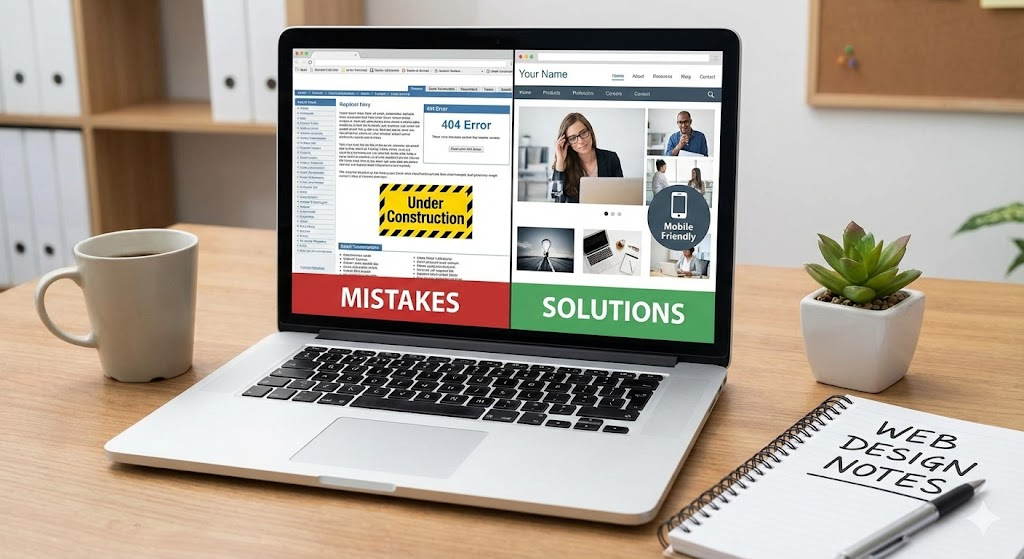
In the high-stakes environment of the London market, your website is often the only chance you get to secure a new client. Whether you are a boutique in Notting Hill or a consultancy in the City, users form an opinion about your brand in approximately 0.05 seconds. If your site is cluttered, slow, or broken, they will click "back" and head straight to your competitor.
At Custom Coded Websites, we frequently audit small business sites that are underperforming. The tragedy is that most of these issues are avoidable. Here are the 10 most common website design mistakes we see small businesses make—and how avoiding them can turn your website into a revenue-generating asset.
1. Ignoring Mobile Responsiveness
London is a commuter city. Thousands of potential customers are browsing your site on the Tube, on buses, or while walking to meetings. If your website requires them to "pinch and zoom" to read your text, you have already lost them.
The Fix: A responsive design is non-negotiable. Unlike rigid templates that often break on different screen sizes, our custom-coded sites are built to flow perfectly across every device, from wide-screen monitors to the smallest smartphones.
2. Slow Loading Speeds
Patience is rare online. Google's data suggests that as page load time goes from 1 second to 3 seconds, the probability of a bounce increases by 32%. Many small businesses unwittingly slow their sites down by using "bloated" themes packed with unnecessary code.
The Fix: Ditch the heavy page builders. We build lightweight, Python-powered sites that load instantly, ensuring you keep the attention of busy Londoners.
3. Cluttered Navigation
Trying to show everything at once is a classic mistake. If a user lands on your homepage and sees a menu with 15 different options, they will suffer from decision paralysis. Complex dropdowns and hidden menus only frustrate visitors.
The Fix: Follow the "Three-Click Rule." Users should be able to find any piece of information on your site within three clicks. Keep your main navigation simple: Home, Services, About, and Contact.
4. Weak or Missing Calls to Action (CTAs)
We see many beautiful brochure sites that fail to do one thing: tell the user what to do next. A passive "Contact Us" link in the footer is not enough. If you want leads, you must ask for them.
The Fix: Use strong, action-oriented verbs. Instead of "Submit," use "Get Your Free Quote" or "Book Your Strategy Session." Place these buttons prominently above the fold.
5. Using Generic Stock Photos
Nothing screams "generic" quite like a photo of a smiling, suit-wearing team high-fiving in a glass office that clearly isn't yours. London consumers are savvy; they can spot a stock photo from a mile away, and it degrades trust.
The Fix: Invest in real photography. Show your actual office in Shoreditch, your real team, or your actual products. Authenticity builds trust faster than any polished stock image ever could.
6. Burying Contact Information
If a client decides they want to hire you, don't make them play detective to find your phone number or email address. Hiding contact info is a major trust signal failure.
The Fix: Place your phone number or a "Contact" button in the top right header of every page. Include a clear footer with your physical address and email. Make it easy for them to give you money.
7. Poor Content Hierarchy (The "Wall of Text")
People don't read websites; they scan them. Large blocks of uninterrupted text are intimidating and hard to digest. If your value proposition is buried in paragraph four, nobody will see it.
The Fix: Break it up. Use descriptive subheadings (H2, H3), bullet points, and short paragraphs. Use bold text to highlight key benefits. Guide the user's eye down the page logically.
8. Neglecting Local SEO
Many small businesses try to rank for broad terms like "Financial Consultant" rather than "Financial Consultant in Canary Wharf." Ignoring your local context means you are competing with the entire world instead of just your borough.
The Fix: We optimise our custom sites with local schema markup and location-specific keywords to ensure you capture the high-intent traffic right on your doorstep.
9. Relying on Insecure Platforms
Using a cheap WordPress theme with 20 outdated plugins is a security nightmare waiting to happen. A hacked website destroys your reputation instantly.
The Fix: Security should be proactive, not reactive. By building with Django and Python, we ensure your site has enterprise-grade security baked in from the very first line of code.
10. "Set It and Forget It" Mentality
Launching the website is the starting line, not the finish line. Many businesses launch a site and never update it again. Outdated content (like a "News" section with the last post from 2019) signals that you might be out of business.
The Fix: treat your website as a living entity. Whether through our Content Management Systems or our maintenance packages, ensure your site evolves alongside your business.
Conclusion
Avoiding these mistakes puts you ahead of 90% of your competition. Your website should be your hardest-working employee—available 24/7, perfectly presented, and always closing deals.
Is your current website guilty of these errors? We can help you build a professional, high-performance digital presence that gets results.