Many business owners view SEO (Search Engine Optimisation) and Web Development as two separate entities. They hire a developer to build a site, and then they hire an SEO specialist to "fix" it. This is an expensive and inefficient approach.
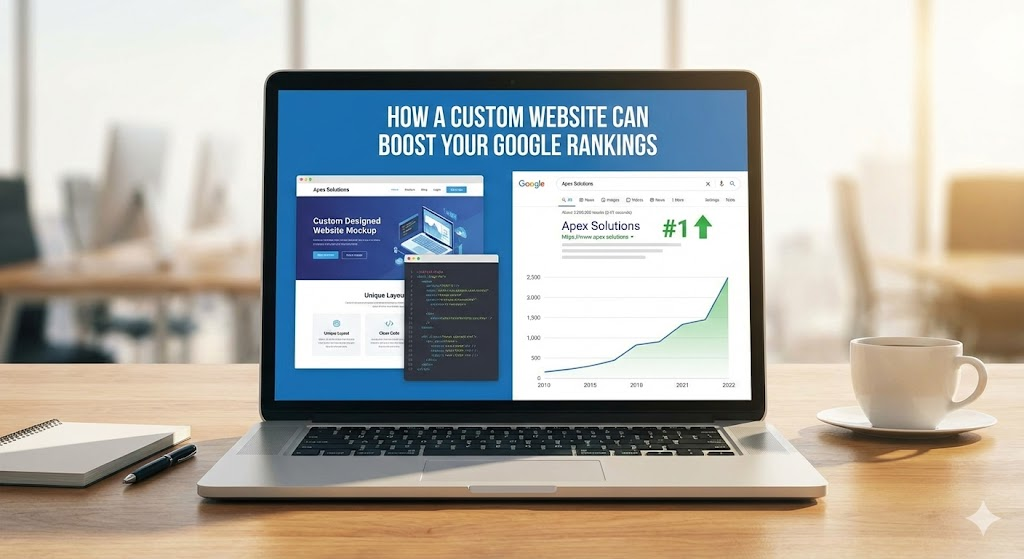
The truth is that high rankings begin with the code itself. Google’s algorithm has evolved significantly; it no longer just counts keywords on a page. It evaluates the experience your website provides—how fast it loads, how stable it is, and how easy it is to navigate. This is where custom-coded websites have a distinct advantage over generic templates. Here is how a bespoke build can be the secret weapon in your SEO strategy.
1. Crushing Core Web Vitals (Speed Wins)
Google’s recent "Core Web Vitals" update made user experience a direct ranking factor. The three main metrics are:
- LCP (Largest Contentful Paint): How fast the main content loads.
- FID (First Input Delay): How fast the site becomes interactive.
- CLS (Cumulative Layout Shift): Visual stability (does the page jump around?).
The Template Problem: WordPress themes and page builders (like Elementor or Divi) often suffer from severe "code bloat." They load massive CSS and JavaScript libraries to support features you aren't even using. This slows down LCP and hurts your score.
The Custom Solution: At Custom Coded Websites, we write code specifically for your site using Python and Django. There is zero bloat. This results in green scores across all Core Web Vitals, signaling to Google that your site is high-quality and deserving of a higher rank.
2. Semantic HTML and Crawlability
Before Google can rank your site, it must read it. "Crawlers" (bots) scan your code to understand what your business does.
The Template Problem: Drag-and-drop builders often generate messy, nested code ("div soup") that makes it hard for bots to distinguish between a main article and a sidebar widget.
The Custom Solution: We use clean, semantic HTML5. We explicitly tell Google, "This is the header," "This is the navigation," and "This is the main article." By making the crawler's job easier, we ensure your content is indexed faster and more accurately.
3. Reduced Bounce Rate through Better UX
Google tracks how users interact with your site. If a user clicks your link, hates the layout, and immediately clicks "Back," this is called a "bounce." A high bounce rate tells Google your site isn't relevant.
Custom websites are designed around your specific user journey, not a generic template structure. By creating a unique, intuitive, and engaging interface, we keep visitors on the page longer. Increased "dwell time" is a strong signal to search engines that your content is valuable.
4. Mobile-First Architecture
Google now uses mobile-first indexing. If your mobile site is slow or broken, your desktop rankings will suffer too.
Templates often use "responsive" hacks that just hide desktop elements on mobile screens, meaning the phone still downloads the heavy desktop images in the background. Our custom approach optimises assets specifically for mobile devices, ensuring the site is truly lightweight and responsive, giving you an edge in mobile search results.
5. Security as a Ranking Signal
Google wants to keep its users safe. HTTPS (SSL) has been a ranking signal for years. However, website integrity goes deeper than just a certificate.
Popular CMS platforms are frequent targets for malware. If your site is hacked, Google will blacklist it immediately, destroying your rankings overnight. By building with Django, a framework known for its robust security features, we protect your site from common vulnerabilities, ensuring your rankings remain safe and stable.
Conclusion
You can write the best content in the world, but if your website’s foundation is shaky, you are fighting an uphill battle. A custom-coded website provides the technical excellence that Google demands.
Stop fixing broken templates and start building for success.
Contact us today to discuss a high-performance, SEO-ready website build.