
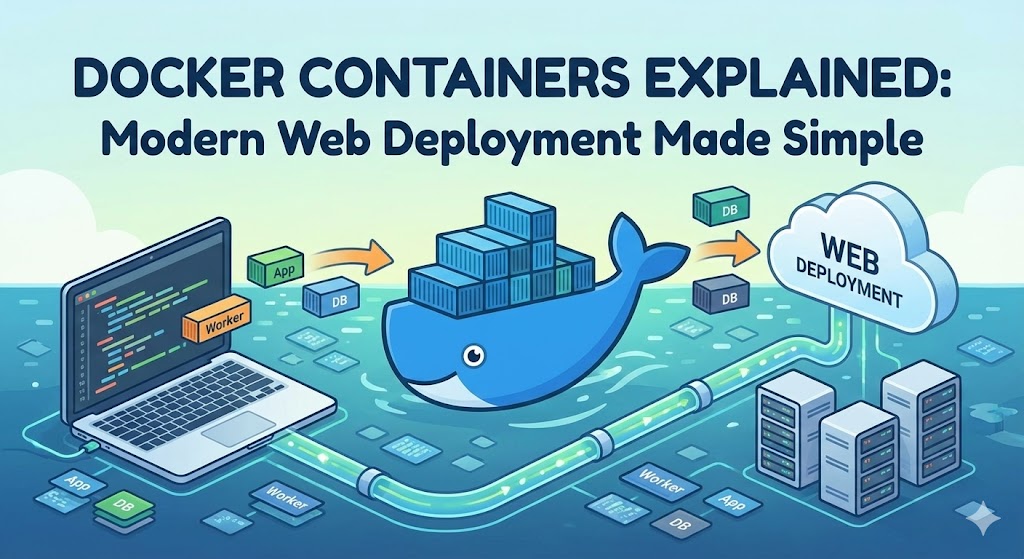
If you have ever managed a software project, you have likely witnessed the "It Works on My Machine" phenomenon. Your developer builds a feature, tests it on their laptop, and says it is perfect. But the moment you upload it to the live server, it crashes.
Why? Maybe the server has a slightly different version of Python. Maybe a specific system library is missing. Maybe the operating system is different. Debugging these environment mismatches costs businesses billions of dollars a year in wasted time.
The solution to this chaos is a technology called Docker.
The Shipping Container Analogy
Before 1960, shipping goods globally was a nightmare. A ship might carry loose sacks of flour, barrels of oil, and crates of furniture. Loading and unloading took weeks because every item required special handling.
Then came the Standard Shipping Container. Suddenly, it didn't matter what was inside (furniture, cars, or electronics). The container was always the same size. It fit on any ship, any truck, and any crane in the world.
Docker is the shipping container for code.
Instead of just sending the code to the server, we wrap the code, the database drivers, the libraries, and the exact version of the operating system tools into a "Container." We then ship the Container. If the Container starts on your developer's laptop, it is guaranteed to start on the server.
Docker vs. Virtual Machines (VMs)
Before Docker, we used Virtual Machines. A VM is like building a separate house for every application. It is secure, but it is heavy and slow because it requires a full Operating System for each app.
Docker Containers are like apartments in the same building. They share the foundation (the host OS kernel) but have their own private walls. This makes them incredibly lightweight.
- Start time: A VM takes minutes to boot. A Docker container takes milliseconds.
- Size: A VM might be 10GB. A Docker container might be 50MB.
Why Your Business Should Care
For non-technical stakeholders, Docker might sound like just another developer tool, but its impact is strategic:
- Faster Onboarding: New developers don't need to spend 3 days setting up their laptops. They typically run one command (docker-compose up) and the entire project is running in 5 minutes.
- Cost Savings: Because containers are lightweight, you can pack more of them onto a single server, reducing your cloud infrastructure bills.
- Parity: Development, Staging, and Production environments are identical. This drastically reduces bugs that only appear after launch.
Summary
Docker has become the industry standard for a reason. It turns the complex, fragile process of software deployment into a predictable, repeatable science. At our agency, every Django project we build is "Dockerized" from day one, ensuring that your application is portable, scalable, and crash-proof.