
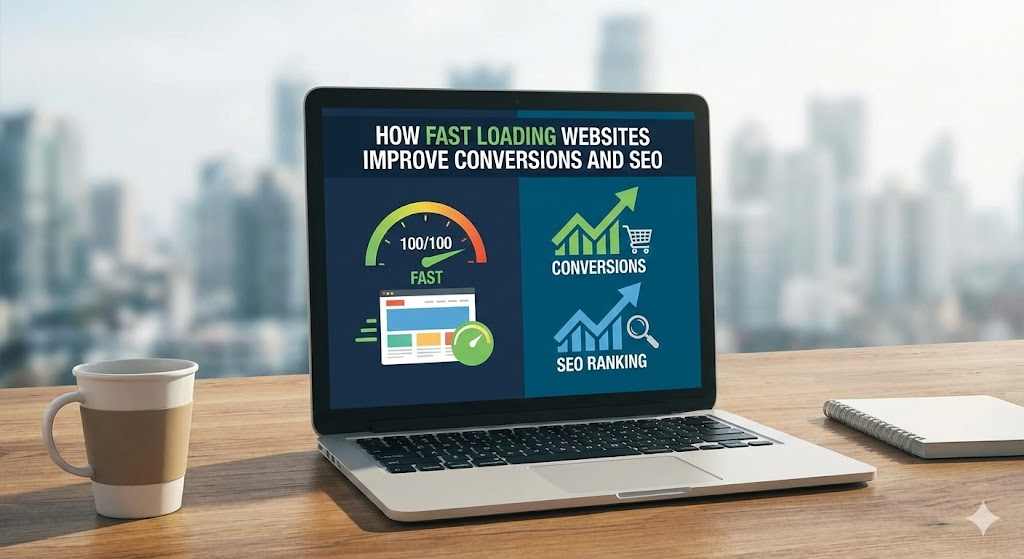
In the digital age, patience is a virtue that your customers simply do not possess. We live in a world of instant gratification. Whether a user is trying to book a table in Soho or find an emergency electrician in Wandsworth, they expect immediate results. If your website leaves them staring at a spinning loading wheel for more than a few seconds, they are gone—likely to a competitor.
At Custom Coded Websites, we view site speed as the single most critical performance metric for modern businesses. It is the foundation upon which User Experience (UX) and SEO are built. Here is a deep dive into why speed matters, how it directly impacts your bottom line, and why custom development is the only way to achieve true performance.
1. The 3-Second Rule: The Psychology of Speed
Studies consistently show that 53% of mobile visits are abandoned if a page takes longer than three seconds to load. This is the "3-Second Rule."
When a user clicks a link, they are making a micro-commitment. If the site fails to load instantly, that commitment breaks, and frustration sets in. In a high-paced city like London, where users are often multitasking or commuting, that tolerance is even lower. A slow website signals incompetence. If you cannot deliver a web page quickly, the customer subconsciously assumes you cannot deliver your service quickly either.
2. Impact on Conversions: Speed Equals Revenue
There is a direct, proven correlation between load times and conversion rates (the percentage of visitors who buy or enquire).
- Walmart found that for every 1 second of improvement in page load time, they experienced a 2% increase in conversions.
- Amazon calculated that a page load slowdown of just one second could cost them $1.6 billion in sales each year.
For a small business, the stakes are just as high. If your website generates £10,000 a month and you have a slow load time causing a 7% drop in conversions (a standard industry statistic for a 1-second delay), you are essentially burning £700 every month. That is £8,400 a year lost to "code bloat."
3. SEO and Google Rankings (Core Web Vitals)
Google is obsessed with speed. They know that if they send users to slow websites, those users stop using Google. Therefore, their algorithm explicitly penalises slow sites.
In recent updates, Google introduced Core Web Vitals, with Largest Contentful Paint (LCP) being the key metric for speed. LCP measures how long it takes for the main content of your page to appear. If your LCP is over 2.5 seconds, Google flags your site as "Needs Improvement" or "Poor."
The Consequence: A poor LCP score pushes you down the search rankings. You could have better content than your competitor, but if their site is faster, they will likely outrank you in the "Near Me" searches.
4. The Mobile Commuter Factor
Consider your typical London client. They might be browsing on the Central Line with spotty 4G, or walking through a busy street. Mobile networks are variable.
Heavy websites built on templates (like standard WordPress themes) often require the user to download 5MB to 10MB of data just to view a homepage. On a patchy mobile connection, this can take 10+ seconds.
The Custom Difference: Our Python/Django sites are optimised to be incredibly lightweight. We serve only the necessary code and compressed images, ensuring that even on a weak signal, your site loads almost instantly. This accessibility captures the mobile traffic that other businesses lose.
5. Why Templates Struggle with Speed
Why are so many websites slow? The culprit is usually "Code Bloat."
When you use a generic website builder (Wix, Squarespace) or a multipurpose WordPress theme, you are loading code for every possible feature the theme offers, whether you use it or not. You might only need a text block, but the theme is loading code for a video slider, a portfolio gallery, and an e-commerce shop in the background.
It is like driving a Ferrari with a trailer full of bricks attached to the back. No matter how good the engine is, the weight will slow you down.
6. The Solution: Custom Coding for Performance
This is where Custom Coded Websites excels. We build with performance as the primary goal, not an afterthought.
- Clean Architecture: We write the HTML and CSS from scratch. There is zero unused code.
- Server-Side Rendering: Using Django, we can render pages on the server before sending them to the browser, which is significantly faster than client-side rendering used by many modern page builders.
- Efficient Database Queries: We optimise how your site talks to the database, ensuring that retrieving product data or blog posts happens in milliseconds.
Conclusion
Speed is not a luxury; it is a fundamental requirement for doing business online in 2025 and beyond. A fast website builds trust, ranks higher on Google, and ultimately puts more money in your pocket.
Stop letting a slow website throttle your growth. Invest in a platform built for speed.
Contact us today for a free speed audit and see how much faster your site could be.