
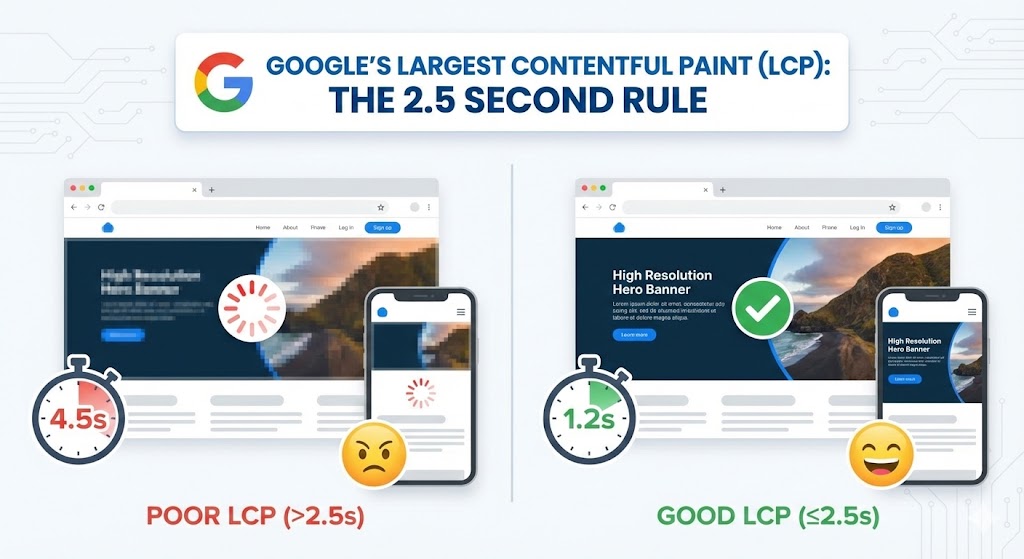
For years, website owners have been obsessing over a metric called First Input Delay (FID). It was one of Google’s "Core Web Vitals," designed to measure how responsive your site was.
But there was a problem: FID was too easy. In fact, over 90% of websites passed the FID test with flying colors, even if the user experience actually felt sluggish. Google realized that FID wasn't capturing the full picture of user frustration.
As of March 2024, Google officially replaced FID with a new, stricter metric: Interaction to Next Paint (INP). If your search rankings have fluctuated recently, this shift might be the culprit.
The Flaw in FID (The "Doorbell" Metric)
FID only measured the delay of the very first interaction a user had with your page (like clicking a menu button). It measured the time between the click and when the browser started processing the code.
Think of it like ringing a doorbell. FID measured how long it took for someone inside to say "Coming!" It did not measure how long it took them to actually walk to the door and open it.
Enter INP (The "Conversation" Metric)
Interaction to Next Paint (INP) is a comprehensive upgrade. It differs from FID in two critical ways:
- It covers the whole session: INP doesn't just look at the first click. It monitors every single click, tap, and keyboard press throughout the user's entire visit and records the worst (slowest) interaction.
- It measures the full cycle: It doesn't just measure the delay before processing; it measures how long it takes for the visual feedback to appear on the screen.
The Three Parts of an Interaction
INP breaks down an interaction into three phases. If any one of these is slow, your score suffers:
- Input Delay: Waiting for the background tasks to finish so the browser can handle the click.
- Processing Time: Running the JavaScript code associated with the button (e.g., calculating a cart total).
- Presentation Delay: The time it takes the browser to physically paint the new pixel (e.g., showing the spinner or opening the menu).
Why JavaScript Frameworks Are Struggling
This change has hit heavy Client-Side Rendered (CSR) sites the hardest. Websites built entirely in React or Angular often rely on the "Main Thread" of the browser to do everything.
If a user clicks "Add to Cart" and the browser is busy parsing a massive JavaScript bundle, the screen freezes. Under FID, this might have been ignored. Under INP, this "freeze" is recorded and penalized.
The Django Advantage
This is where Server-Side Rendering (SSR) with Django shines. Because Django sends HTML that is ready to be displayed, the browser's Main Thread is less cluttered with heavy JavaScript execution.
While we still use JavaScript for interactivity, minimizing the amount of code running in the browser (often by using tools like HTMX) ensures that when a user clicks, the browser is free to respond instantly.
Summary
The transition from FID to INP is Google's way of saying, "Stop optimizing just for the test." INP forces developers to optimize for the actual human experience of using a website. If your site feels fast to you, but Google says your INP is "Poor," it means your users are experiencing freezes you aren't seeing.