If you have ever written a university essay or a critical business proposal, you are likely familiar with a file folder that looks like this:
- proposal.docx
- proposal_v2.docx
- proposal_final.docx
- proposal_final_FINAL_real.docx
This is "primitive version control." It is messy, confusing, and prone to error. In the world of software development, where a single project contains thousands of files and millions of lines of code, this method would be a disaster.
Instead, professional developers use a tool called Git. Git is a distributed version control system that acts as a comprehensive safety net for your investment.
The "Time Machine" Concept
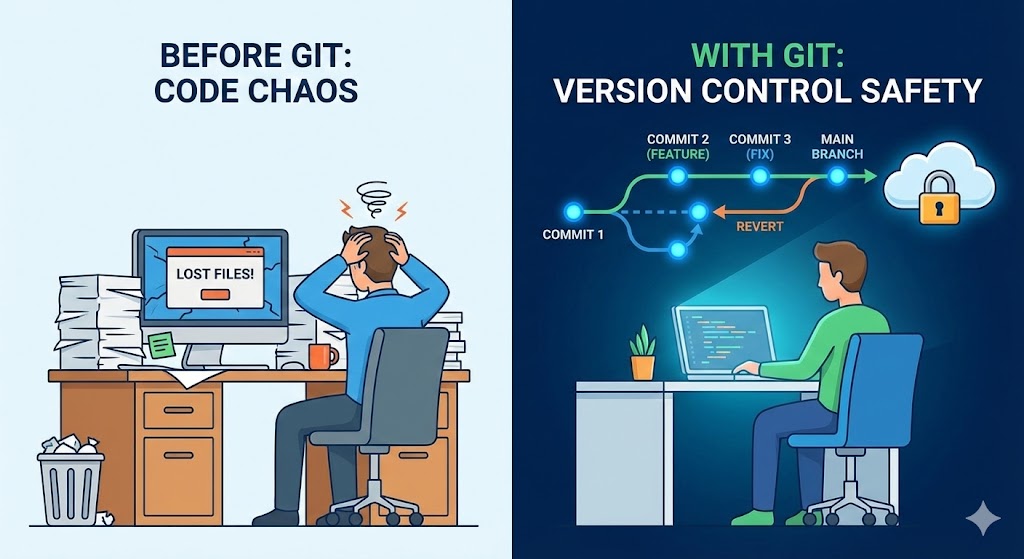
At its core, Git is a time machine. Every time a developer makes a significant change to the code—whether it’s adding a new feature or fixing a typo—they create a "Commit."
A Commit is a snapshot of the entire project at that exact moment in time. It includes:
- Exactly what lines of code changed.
- Who made the change.
- When they made it.
- A message explaining why they made it.
If we deploy a new feature on Tuesday and it accidentally breaks the checkout page, we don't panic. We simply "revert" to the Monday snapshot. The error disappears instantly.
Parallel Universes (Branching)
The most powerful feature of Git for business owners to understand is Branching. This allows us to work on new features without disturbing the live website.
Imagine your website is a highway. Traffic is flowing smoothly (this is the "Main" branch). You want to build an exit ramp (a new feature). Without Git: We would have to build the ramp right on the active highway, causing traffic jams (bugs) for your users. With Git: We create a "Feature Branch." This is a parallel copy of the highway where we can construct the ramp in isolation. We can break things, fix them, and test them perfectly.
Only when the ramp is perfect do we "Merge" it back into the main highway. Your users get the new feature instantly, without ever seeing the construction chaos.
The Distributed Backup
Git is also a disaster recovery tool. Unlike a Word document saved on one laptop, a Git project is "distributed."
This means every developer on the team has a full copy of the project history on their machine. Additionally, there is a central copy stored in the cloud (usually on platforms like GitHub or GitLab).
If our office burns down, or a developer’s laptop is stolen, your code is safe. We simply buy a new laptop, "clone" the repository from the cloud, and we are back to work in minutes.
Summary
Git is the difference between amateur coding and professional software engineering. It provides an audit trail for every line of code, facilitates teamwork without conflict, and ensures that no matter what happens, we can always hit "Undo."