
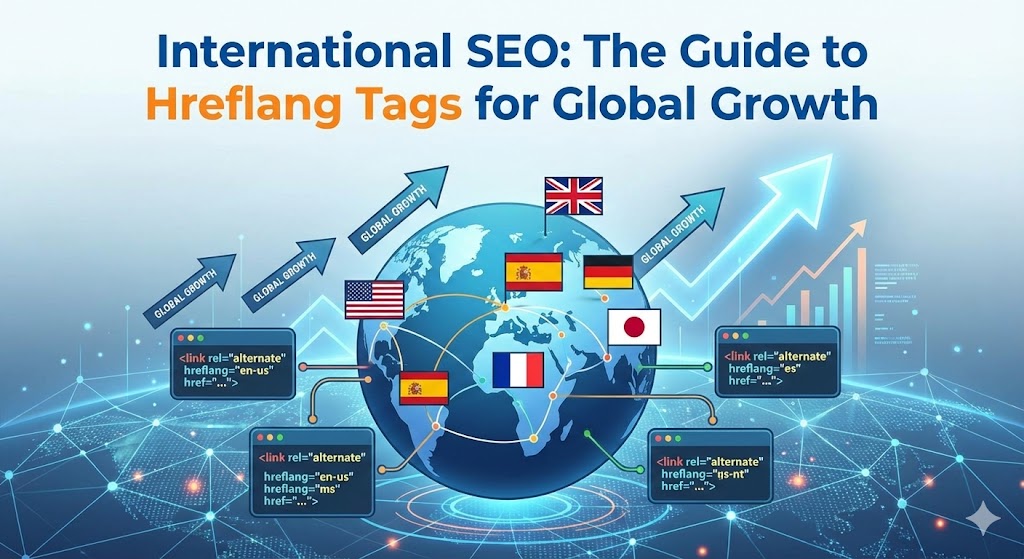
You have successfully conquered your local market. Now, you are expanding. You launch a German version of your site for Berlin, a US version for New York, and a UK version for London.
Suddenly, your traffic flatlines. Your UK customers are landing on the US site (seeing the wrong currency), and Google is flagging your English pages as "Duplicate Content."
The solution to this chaos is one of the most complex, yet essential, lines of code in SEO: the hreflang tag.
The Problem: The "Duplicate Content" Trap
To a search engine, an English page for the UK and an English page for the US often look 99% identical. Maybe the spelling of "color" vs "colour" changes, and the currency switches from £ to $, but the rest is the same.
Without instructions, Googlebot gets confused. It picks one version to rank and hides the other to prevent "spam." This means your American customers might see the UK site, or worse, neither site ranks well.
The Solution: Hreflang (The Digital Passport)
The hreflang attribute is a signal that tells Google: "These pages are identical in content, but they are intended for different audiences."
It acts like a traffic controller. When a user searches from Paris, hreflang ensures they see the French version. When they search from London, they see the British version.
The Anatomy of the Tag
Hreflang tags usually live in the <head> section of your HTML. They look like this:
<link rel="alternate" hreflang="en-gb" href="https://example.com/uk/" /> <link rel="alternate" hreflang="en-us" href="https://example.com/us/" /> <link rel="alternate" hreflang="es" href="https://example.com/es/" /> There are two parts to the code:
- Language Code (ISO 639-1): e.g., en (English), es (Spanish), de (German).
- Region Code (ISO 3166-1 Alpha 2): e.g., gb (United Kingdom), us (United States), au (Australia).
The Golden Rules of Hreflang
Implementing these tags is notoriously difficult to get right. One small error can invalidate your entire international SEO strategy.
1. The "Return Tag" Rule
Hreflang is a relationship. If Page A points to Page B, Page B must point back to Page A. If the link is not reciprocal, Google ignores it entirely.
2. The Self-Referencing Tag
It feels redundant, but Page A must also point to itself. If you have three versions (UK, US, FR), every single page must list all three links in the header.
3. The x-default Tag
What if a user visits from a country you haven't optimized for, like Japan or South Africa? You use the x-default tag to tell Google which version is the "fallback" (usually the main international .com site).
Handling This in Django
Hardcoding these tags on every page is impossible for large sites. At our agency, we automate this using Django's powerful internal logic.
We configure your base.html template to dynamically loop through the available languages for the current page. If you add a new country in the CMS, the hreflang tags automatically update across thousands of pages instantly. This automation ensures you never face the "Return Tag" error.
Summary
International SEO isn't just about translation; it's about technical precision. Correctly implemented hreflang tags ensure that your customers land on the page that speaks their language—and accepts their currency.