
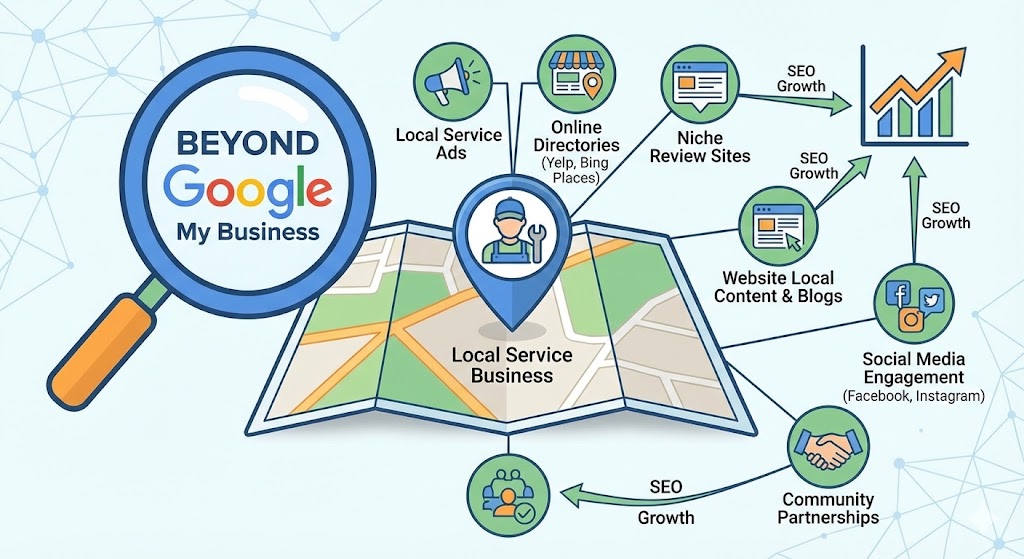
For most service businesses—whether you are a plumber, a law firm, or a specialized consultancy—Local SEO begins and ends with setting up a Google Business Profile (formerly Google My Business). While this is undeniably the most critical first step, stopping there is a mistake.
Google’s algorithm determines your local ranking based on three pillars: Relevance, Prominence, and Proximity. Your profile covers "Proximity," but your actual website is responsible for "Relevance" and "Prominence."
If you want to rank not just for "Plumber near me" (which relies on GPS) but for "Best Plumber in [City Name]" (which relies on authority), you need to optimize your web infrastructure.
1. The Power of "Location Pages"
If you serve multiple cities or suburbs, your homepage cannot rank for all of them. You need specific landing pages for each service area.
The Strategy: Create a unique page for every major city you serve. Bad: One page listing 10 cities. Good: yoursite.com/plumber-bristol, yoursite.com/plumber-bath, yoursite.com/plumber-swindon.
Each page needs unique content (not just copy-pasted text) that mentions local landmarks, specific services relevant to that area, and reviews from customers in that specific zip code.
2. NAP Consistency: The Trust Signal
Google is paranoid. It wants to be 100% sure that if it sends a user to your address, you will actually be there. It verifies this by checking your NAP (Name, Address, Phone) across the entire internet.
If your website says "123 Main St," but your Yelp profile says "123 Main Street, Suite 4," and your Facebook says "123 Main," Google gets confused. Inconsistency kills rankings. You must ensure your NAP is character-perfect across your website footer, contact page, and every directory you are listed on.
3. Local Business Schema (Structured Data)
As developers, this is our favorite tool. Schema Markup is code that you put on your website that helps Google understand exactly what you are.
For a service business, we implement LocalBusiness schema. This code explicitly tells Google:
- Your exact GPS coordinates.
- Your opening hours.
- The specific "Service Area" (cities) you cover.
- Your price range.
While a human user never sees this code, Googlebot reads it and uses it to confidently place you in the Map Pack.
4. Local Backlinks
Links from the New York Times are great, but for a local electrician, a link from the local High School football team or the Chamber of Commerce is actually more valuable for Local SEO.
Google looks for "hyper-local" relevance. Sponsoring a local event or getting featured in a neighborhood blog sends a strong signal that you are a pillar of that specific community.
Summary
A Google Business Profile gets you on the map. A fully optimized local website keeps you there. By combining location-specific landing pages with technical schema markup, you prove to Google that you are the authority in your region.