
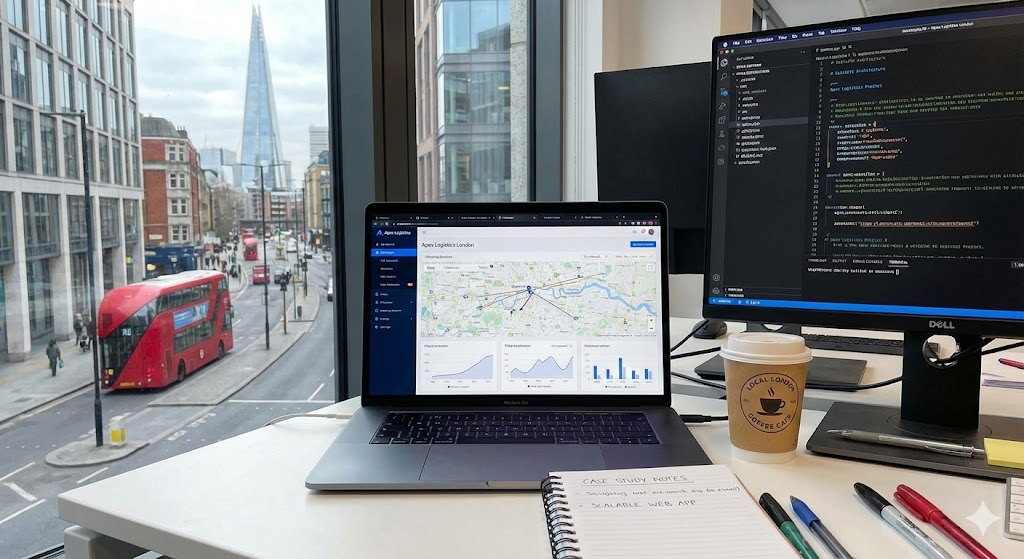
In the fast-paced world of logistics, data latency isn't just a technical glitch—it’s a direct hit to the bottom line. Apex Logistics London, a premier courier and freight firm based near Heathrow, found themselves at a breaking point. Their legacy management system, built on an aging PHP framework, was struggling to handle real-time data from over 150 vehicles operating across London and the Home Counties. They needed a partner to build a scalable, future-proof solution. They chose Custom Coded Websites.
The Problem: A System Overloaded by Growth
As Apex Logistics expanded their operations in the London Docklands and West End, their existing platform began to buckle. The primary issues were clear and detrimental to their daily operations:
- Database Bottlenecks: The old system could not process concurrent GPS pings and client booking requests, leading to frequent timeouts.
- Lack of Real-Time Updates: Dispatchers were forced to manually refresh pages to see vehicle locations, causing delays in re-routing during London’s unpredictable traffic spikes.
- Security Risks: Running on outdated software meant the company was increasingly vulnerable to data breaches, a major concern for their high-contract corporate clients.
The CCW Strategy: Why Django was the Only Choice
When our co-founders, Charlie Shortman and Louie Long, sat down with the Apex leadership team, the recommendation was immediate: a bespoke Django Web Application. Unlike off-the-shelf logistics software or general-purpose CMS platforms, a custom Django build offers the "batteries-included" security features and the mathematical precision required for complex logistics logic.
Building the Backend Engine
Our Lead Developer, Charlie Shortman, took charge of the backend architecture. The goal was to build a system that wasn't just fast today, but scalable for the next decade. We implemented a PostgreSQL database optimized with complex indexing to handle thousands of writes per minute. By utilizing Django’s Object-Relational Mapper (ORM), we created a clean, maintainable data structure that allows Apex to pull granular reports on fuel efficiency, driver performance, and delivery windows in milliseconds.
Real-Time Dispatch with Django Channels
To solve the "manual refresh" problem, we implemented Django Channels. This allowed us to use WebSockets to push real-time updates to the dispatchers' dashboards. Now, when a van moves through the Blackwall Tunnel or makes a drop-off in the City of London, the dashboard updates instantly without the user ever clicking a button. This real-time synchronization transformed their Shoreditch-based dispatch hub into a high-tech command center.
The User Experience: Designed by Louie Long
Functionality is useless if it’s difficult to navigate. Our full-stack specialist, Louie Long, designed a custom administrative interface that stripped away the clutter of their previous system. We focused on a "high-density information" design, ensuring that dispatchers could see vehicle status, driver contact info, and customer priority levels on a single screen. The frontend was built to be ultra-responsive, ensuring that field managers could access the full power of the application from their tablets while on-site at Heathrow or the London Gateway port.
Overcoming the "Template" Trap
One of the biggest concerns Apex had was whether to simply buy a subscription to a SaaS logistics platform. We demonstrated that "renting" their core infrastructure would lead to long-term costs and zero customization. By choosing Custom Coded Websites, Apex Logistics now owns every line of code. There are no monthly "per-user" fees, and they have the freedom to add new features—such as AI-driven route optimization—whenever they choose, without waiting for a third-party provider's update cycle.
The Results: Efficiency at Scale
Since the launch of the custom Django application, the impact on Apex Logistics London has been transformative:
- 40% Increase in Operational Efficiency: Automated dispatching logic has reduced the time spent on manual scheduling by nearly half.
- Zero Downtime: Since deployment, the application has maintained 100% uptime, even during peak seasonal rushes like Black Friday and the lead-up to Christmas.
- Reduced Fuel Costs: Better routing and real-time data have helped the fleet avoid London’s worst congestion zones, cutting fuel expenditure by 12% in the first six months.
- Future-Proofing: The application is currently being integrated with an automated billing system, a feature that would have been impossible with their old template-based software.
Conclusion: Scaling Your London Business with Custom Code
Apex Logistics is now a technology-led company that happens to do logistics. Their new platform is a testament to what is possible when you move away from generic web builders and invest in high-grade Python and Django engineering.
At Custom Coded Websites, we don’t just build websites; we build the digital infrastructure that allows London businesses to compete on a global stage. Whether you are in logistics, finance, or e-commerce, your software should be your greatest asset, not your biggest bottleneck.