
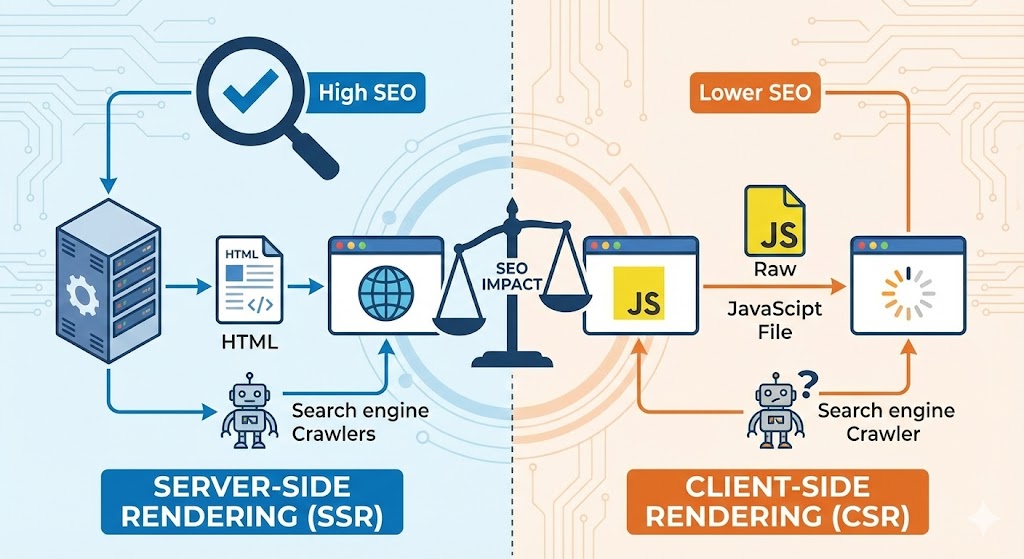
In the world of web development, there is a constant tug-of-war between developer experience and user experience. Developers love the fluidity of modern JavaScript frameworks (like React, Vue, and Angular), but search engines—and users with slow connections—often prefer the stability of traditional HTML.
The core of this debate lies in Rendering: Where does your code turn into a viewable website? Does it happen on your powerful server (Server-Side Rendering), or on the user's laptop (Client-Side Rendering)? If you care about ranking on Google, the answer isn't just technical—it's strategic.
What is Client-Side Rendering (CSR)?
In Client-Side Rendering, your server sends a mostly empty HTML file to the browser. This file contains a massive bundle of JavaScript. Once the browser downloads this bundle, it executes the code to "build" the website right before the user's eyes.
Think of it like buying IKEA furniture: the delivery truck (server) drops off a flat-pack box (code), and you (the client) have to assemble it before you can use it.
The SEO Problem with CSR
For years, Google struggled to "read" CSR websites. While their bots have gotten smarter at executing JavaScript, it is still a risky bet for SEO.
- The Rendering Queue: Google crawls your site in two waves. First, it scrapes the HTML (which is empty in CSR). Then, it queues your site to be "rendered" later when resources allow. This can delay your indexing by days or weeks.
- Crawl Budget Waste: Because rendering JavaScript is expensive, Googlebot might give up halfway through your site if it takes too long to load, leaving pages unindexed.
What is Server-Side Rendering (SSR)?
In Server-Side Rendering, the server does the heavy lifting. When a user requests a page, the server compiles the data, builds the HTML, and sends a fully finished page to the browser. The browser just has to display it.
Using the furniture analogy: The delivery truck arrives with a fully assembled sofa. You can sit on it immediately.
The SEO Advantage of SSR
SSR is generally considered the "Gold Standard" for SEO-critical pages for three reasons:
- Instant Readability: When Googlebot hits your URL, it sees the full content (text, links, metadata) immediately. There is no waiting for JavaScript to load.
- Faster First Contentful Paint (FCP): Users see the content faster, which improves your "Core Web Vitals" score—a major ranking factor.
- Social Sharing: Ever shared a link on Slack or Twitter and the preview image didn't load? That is often a CSR failure. SSR ensures your "Open Graph" tags are always readable by social bots.
The Middle Ground: Static & Hybrid Rendering
In 2025, you rarely have to choose one extreme. Modern frameworks (like Next.js for React or Nuxt for Vue) and Django itself allow for hybrid approaches.
Static Site Generation (SSG) is often the best winner for SEO. Pages are rendered once at "build time" and stored as static files. They load instantly and are perfect for blogs, marketing pages, and portfolios.
Summary: Which Should You Choose?
| Scenario | Recommended Approach |
|---|---|
| Public Marketing Pages | SSR or Static (Best for SEO) |
| Blog / News Site | SSR or Static (Crucial for indexing) |
| User Dashboard (Private) | CSR (SEO is irrelevant here) |
| E-Commerce Listings | SSR (Speed + Indexing) |
At our agency, we build with Django because it defaults to Server-Side Rendering. This ensures that the foundation of your business is indexable, fast, and robust from day one.