If you are planning to launch or upgrade an online store in 2026, the first roadblock you will hit is the platform debate. Do you go with a popular "Software as a Service" (SaaS) platform like Shopify, or do you invest in a fully custom-coded e-commerce website?
It is the digital equivalent of renting a shop in a shopping centre versus building your own flagship store on the high street. One offers convenience and a quick setup; the other offers total control, ownership, and unlimited potential. At Custom Coded Websites, we help London businesses make this transition every day. To help you decide, here is an honest breakdown of the pros and cons of both approaches.
Shopify: The "Ready-Made" Solution
Shopify is a giant for a reason. It has lowered the barrier to entry, allowing anyone to start selling t-shirts from their bedroom in minutes. But does it suit a scaling business?
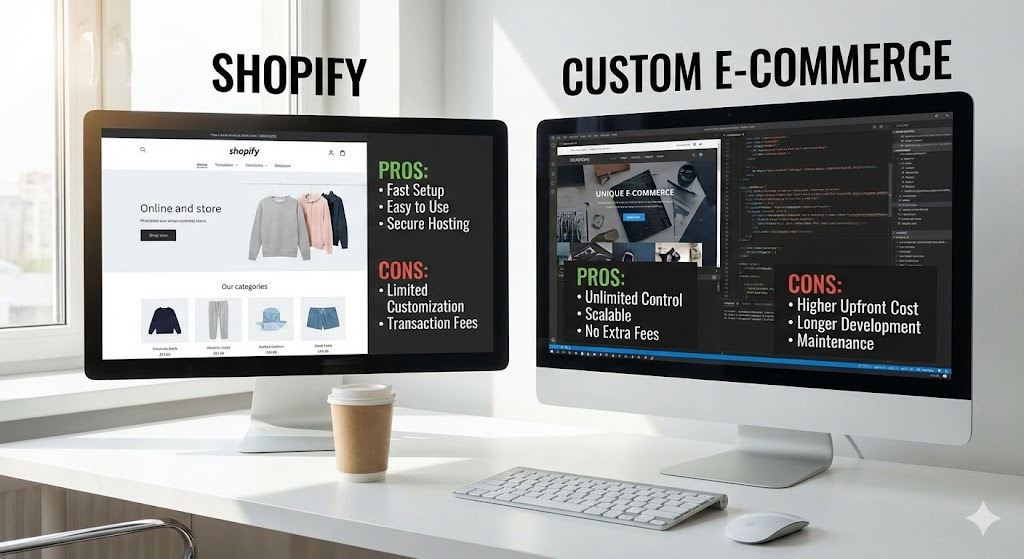
The Pros of Shopify
- Fast Setup: You can pick a theme, upload products, and be live within a weekend.
- User-Friendly: The backend is designed for non-technical users.
- App Ecosystem: There is an app for almost everything, from reviews to email marketing.
The Cons of Shopify
- "The Landlord" Problem: You don't own your store; you rent it. If Shopify changes their terms or prices (which they frequently do), you have no choice but to pay.
- Transaction Fees: Unless you use Shopify Payments, you are charged an extra transaction fee on top of your credit card processing fees. This "tax on success" adds up to thousands of pounds as your revenue grows.
- The "App Trap": While apps are great, they cost money. A "free" Shopify store often ends up costing £300+ a month in app subscriptions just to get basic functionality like advanced filtering or loyalty programs.
- SEO Limitations: Shopify has rigid URL structures (e.g., forcing /products/ into URLs) that you cannot change, which can frustrate technical SEO efforts.
Custom E-Commerce (Python & Django): The "Bespoke" Solution
A custom-coded site is built from the ground up, typically using a powerful framework like Django. This is the route taken by major brands and serious scale-ups who need specific functionality that templates can't handle.
The Pros of Custom Development
- Total Ownership: You own the code and the data. You can host it anywhere (AWS, DigitalOcean, Heroku). No platform can shut you down or hike your rent.
- Infinite Customisation: When we built the platform for Anime Weebs, they needed a specific "limited drop" system that locked inventory in real-time for high-demand launches. Shopify struggles with this kind of custom logic; with Python, it is standard procedure.
- Performance & Speed: Without the bloat of generic themes, custom sites are lightning-fast. This improves your conversion rates and Google rankings.
- No Transaction Fees: You choose your payment gateway (Stripe, PayPal, Adyen) and pay only their standard fees. There is no middleman taking a cut of your hard-earned sales.
- Scalability: Custom architectures are built to handle millions of products and users without breaking a sweat.
The Cons of Custom Development
- Higher Upfront Cost: You are paying for skilled engineering, not a £50 template. The initial investment is higher.
- Longer Build Time: Quality takes time. A custom build might take weeks or months depending on complexity, compared to days for a basic Shopify store.
The Comparison: Costs vs. Value
Many business owners look only at the setup cost, but the Total Cost of Ownership (TCO) over three years tells a different story.
Shopify TCO: Lower upfront cost + Monthly Platform Fees + Monthly App Fees + Transaction Fees on every sale. Over three years, a successful store can pay tens of thousands in fees.
Custom TCO: Higher upfront cost + Low Hosting Fees + Maintenance. Once the code is written, it is yours. As your sales double, your costs remain flat. This makes custom development significantly cheaper in the long run for high-volume businesses.
Which is Right for You?
Choose Shopify If:
You are a startup testing a new product idea with a low budget. If you are making less than £50,000 a year, the ease of Shopify outweighs the limitations.
Choose Custom Development If:
You are an established business or a funded startup expecting rapid growth. If you have unique requirements (e.g., complex shipping rules, custom product builders, or B2B portals) or simply want to stop paying "rent" on your own business, custom is the only viable path.
Conclusion
Your e-commerce platform is the foundation of your business. While Shopify is a fantastic starting block, many ambitious London businesses eventually hit a "glass ceiling" where the platform limits their growth.
At Custom Coded Websites, we specialise in breaking those ceilings. We build high-performance, fee-free platforms that belong to you.
Thinking of migrating from Shopify or starting fresh? Contact us for a consultation today.