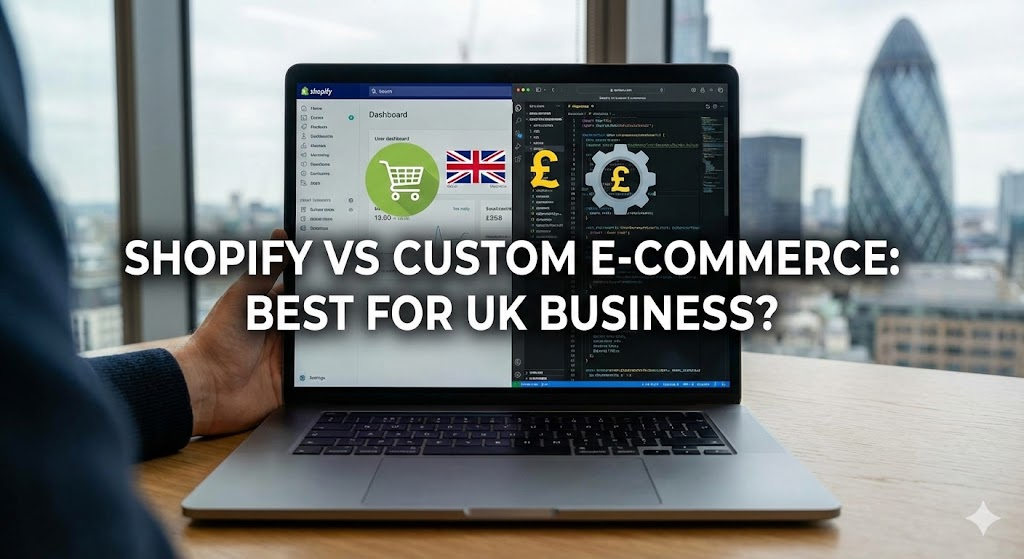
For any small business in London looking to sell online, the first question is usually: "Should I use Shopify, or should I build something custom?"
Shopify (and similar platforms like Wix or Squarespace) has done an incredible job of democratizing e-commerce. They make it easy to start a shop in an afternoon. However, as your business grows, ease of setup often gets replaced by the frustration of limitations. At Custom Coded Websites, we work with many clients who started on Shopify but hit a "glass ceiling" and needed to migrate to a robust, custom-built solution.
Here is a breakdown of the pros, cons, and hidden costs of Shopify versus a custom Python/Django e-commerce site, so you can make the right investment for your business.
The Analogy: Renting vs. Owning
The best way to understand the difference is to compare it to the UK property market.
- Shopify is like renting a shop in a shopping centre. It is quick to move in, and the landlord handles the security and the plumbing. However, you can't knock down walls, you have to follow their strict rules, and if they decide to raise the rent (or transaction fees), you have no choice but to pay. Ultimately, you do not own the building.
- A Custom Website is like buying your own freehold building. It takes a bit longer to build, but you own every brick. You can paint it whatever colour you want, extend it whenever you like, and—crucially—you don't pay a landlord a percentage of your monthly earnings.
1. The "Success Tax": Transaction Fees vs. Fixed Costs
One of the biggest shocks for scaling businesses on Shopify is the cost structure. Shopify charges a monthly subscription, but the real cost lies in the transaction fees.
Unless you use Shopify Payments, they charge a transaction fee on every sale (up to 2%) on top of your credit card processor fees. As your revenue hits £50k, £100k, or £1m a year, that percentage adds up to a massive amount of lost profit.
The Custom Advantage: With a custom-coded site, you pay for the build and a small hosting fee. You integrate directly with payment gateways like Stripe or PayPal. We do not charge transaction fees. If you make £1 million, you keep it. Over 3-5 years, the savings on a custom site often pay for the initial development cost multiple times over.
2. The "App Trap" vs. Built-in Features
Shopify core is actually quite basic. To get functionality like "Pre-Orders," "Advanced Filtering," "Loyalty Programs," or "SEO optimisations," you usually have to install third-party Apps.
These apps often cost between $10 and $100 per month each. We see small businesses paying hundreds of pounds monthly just for plugins. Furthermore, these apps often conflict with each other and slow down your site.
The Custom Advantage: When we build a site using Python and Django, we code these features directly into the core. You don't pay a monthly subscription for a "Wishlist" feature or a "Mega Menu." It is built once, it belongs to you, and it runs without bloating your code.
3. Design: Cookie-Cutter vs. Bespoke Brand Identity
In a competitive market like London, standing out is vital. The problem with templates is that thousands of other shops use the exact same layout. Consumers are savvy; they can spot a standard Shopify theme a mile away.
The Custom Advantage: We start with a blank canvas. We design the User Experience (UX) around your specific product and customer journey. Do you need a 3D product configurator? A unique storytelling scroll? A non-grid layout? With custom code, the only limit is your imagination, not the template's settings.
4. SEO: Fighting with URL Structures
Search Engine Optimization (SEO) is how you get traffic without paying for ads. Shopify has a rigid URL structure that you cannot change (e.g., forcing /collections/ or /pages/ into every link). This isn't ideal for advanced SEO strategies or site architecture.
The Custom Advantage: Our Django sites offer complete control over URL structures, metadata, and schema markup. We can build "Programmatic SEO" pages that target thousands of specific keyword variations (e.g., "Blue Leather Handbag London") without creating messy duplicate content. This gives you a significant technical edge over competitors using out-of-the-box solutions.
5. Scalability and Performance
As you add products and apps to a template site, it gets heavier. Slow websites kill conversions. If your site takes 4 seconds to load on a mobile device, you are losing 40% of your visitors.
The Custom Advantage: Django is designed for high performance (it powers Instagram and Pinterest). We optimize every line of code. We optimize images automatically. We ensure that even with 10,000 products, your site loads lightning fast. This scalability means you won't have to "re-platform" in two years when you grow too big.
Verdict: Which is Right for You?
Choose Shopify if:
- You are a brand new startup with zero budget.
- You have no technical knowledge and just want to test a product idea.
- You are happy with a generic look and standard features.
Choose Custom Coded (Django) if:
- You are an established business looking to scale and reduce long-term costs.
- You have specific needs (e.g., custom product builders, complex shipping logic).
- You want to own your platform and avoid monthly app fees.
- You are in a competitive niche where design and SEO performance are critical.
Ready to stop renting and start owning? Contact Custom Coded Websites today for a consultation on building your bespoke e-commerce empire.