
If you are still saving images as standard JPEGs in 2025, you are voluntarily slowing down your website. Images account for the vast majority of bandwidth on the modern web, and optimizing them is the single most effective way to improve your Core Web Vitals and SEO rankings.
For the last few years, the advice was simple: "Use WebP." But the landscape has shifted. A new champion (AVIF) has taken the throne, and a fallen hero (JPEG XL) is making a massive comeback. We break down exactly which format you should use to get that perfect 100/100 Google Speed score.
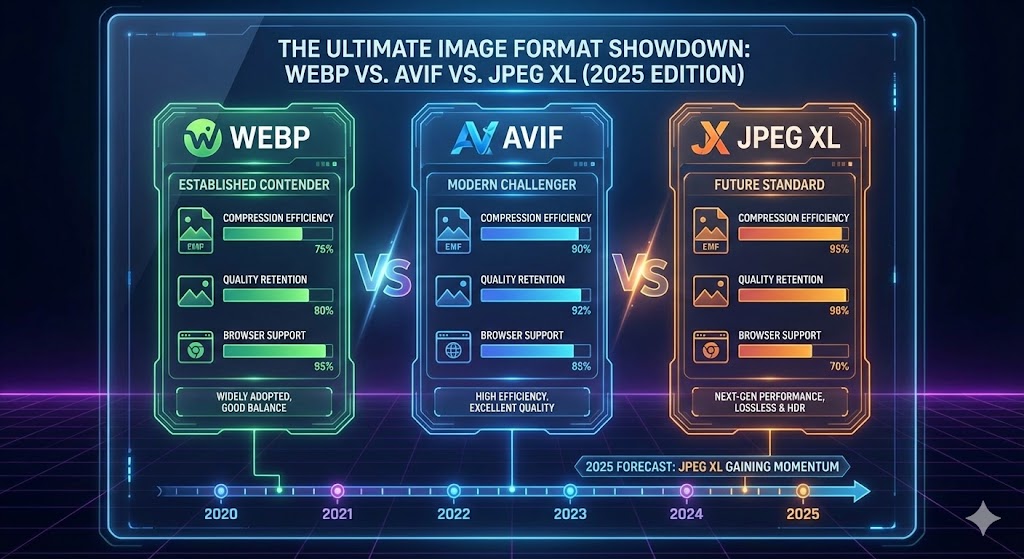
1. WebP: The "Old Reliable"
Google released WebP over a decade ago to replace JPEG and PNG. It is versatile, supporting both transparency (like PNG) and animation (like GIF) in a single format.
- Compression: Typically 30% smaller than JPEG.
- Browser Support: 100%. Every browser, from Chrome to Safari to Edge, supports it natively.
- The Verdict: WebP is no longer "next-gen"; it is the minimum standard. It is the safest fallback, but it is no longer the smallest.
2. AVIF: The Compression King
AVIF (AV1 Image File Format) is currently the undisputed king of compression. Derived from modern video coding, it is incredibly efficient at crunching down file sizes without destroying visual quality.
- Compression: Up to 50% smaller than JPEG and 20% smaller than WebP.
- The Superpower: It handles "noisy" images and sharp gradients much better than WebP, which often gets blurry at low file sizes.
- The Verdict: This is the Best Choice for SEO in 2025. If you want the fastest possible Largest Contentful Paint (LCP) score, serve AVIF.
3. JPEG XL: The "Comeback Kid"
JPEG XL (JXL) has had a dramatic history. After being removed from Chrome in 2022, it was recently announced that support is coming back to Chromium. Why? because it offers something AVIF cannot: perfect, reversible compression.
- The Superpower: Lossless Transcoding. You can take an old library of JPEGs, convert them to JXL to save 35% space, and convert them back to the exact original pixel-perfect JPEG later.
- Progressive Loading: JXL loads in a "blurry-to-sharp" stream (like old JPEGs), whereas AVIF simply pops in when fully downloaded.
- The Verdict: It is the future of professional photography portfolios, but browser support is still catching up compared to AVIF.
Head-to-Head Comparison
| Feature | WebP | AVIF | JPEG XL |
|---|---|---|---|
| File Size | Good | Best (Tiny) | Great |
| Quality | Okay | Excellent | Best (High Fidelity) |
| Browser Support | Universal | Excellent (95%+) | Growing Fast |
| Encoding Speed | Fast | Slow | Fast |
Our Recommendation for Django Developers
You don't have to choose just one. Using the HTML <picture> tag, you can let the browser choose the best format it supports. We recommend this "waterfall" approach:
<picture> <!-- 1. Serve AVIF to modern browsers (Fastest) --> <source srcset="image.avif" type="image/avif">

<!-- 2. Serve WebP to older browsers (Reliable) --> <source srcset="image.webp" type="image/webp">

<!-- 3. Fallback to JPEG for ancient devices --> <img src="image.jpg" alt="Description"> </picture>
Summary
In 2025, AVIF is the winner for general web delivery and SEO speed. However, with JPEG XL support returning to Chrome, we are keeping a close eye on it for high-resolution gallery sites. For now, upgrade your pipeline to generate AVIFs, and watch your load times drop by half.