London is a global capital of design. From the fashion houses of Bond Street to the creative agencies of Shoreditch, the city sets the visual standard for the world. In the digital realm, standing still is the same as moving backward. If your website looks like it was built in 2020, your customers will notice.
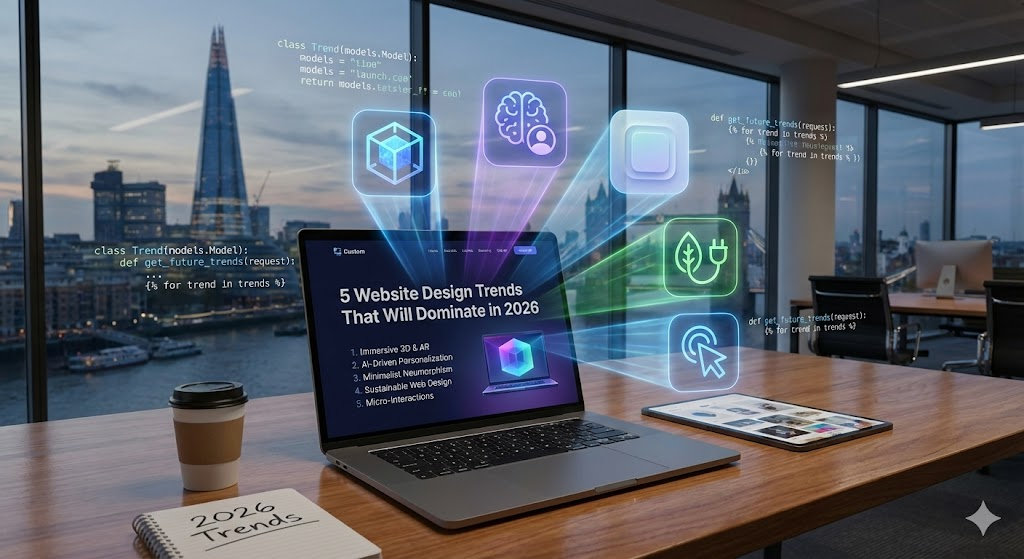
As we look ahead to 2026, we are seeing a shift away from the rigid, cookie-cutter templates that dominated the last decade. The future is fluid, interactive, and intelligent. At Custom Coded Websites, we don't just follow trends; we build the infrastructure that makes them possible. Here are the five key design trends that will dominate the landscape in 2026.
1. Immersive "Scrollytelling"
Static pages are out. "Scrollytelling" (storytelling via scrolling) is in. As users scroll down your page, elements shouldn't just sit there; they should move, assemble, and guide the narrative. Think of a property developer's site where the building constructs itself as you scroll, or a product page where the item rotates 360 degrees.
The Tech Requirement: This requires heavy JavaScript libraries like Three.js or GSAP. If you try to do this on a standard Wix or WordPress template, the site will likely freeze or stutter. Custom coding ensures these animations are optimised and hardware-accelerated, providing a buttery-smooth experience that keeps users hooked.
2. Eco-Minimalism (The Low-Carbon Web)
Sustainability is no longer just a buzzword; it is a business metric. With London businesses striving for Net Zero, your digital carbon footprint matters. Heavy, bloated websites consume massive amounts of electricity in data centres.
The Trend: Expect to see "Eco-Minimalism"—designs that look stunning but use less energy. This means darker colours (which save battery on OLED screens), fewer heavy videos, and cleaner code. Because our Python/Django sites have zero code bloat, they are naturally more energy-efficient, helping you meet your ESG goals while speeding up your site.
3. AI-Dynamic Interfaces
In 2026, a "one-size-fits-all" interface will feel archaic. Why should a returning VIP client see the same "Welcome" message as a first-time visitor?
The Trend: Websites will use AI to adapt the layout in real-time. If a user always checks your "Services" page, the site might move that button to the centre of the screen on their next visit. This level of hyper-personalisation requires a powerful Python backend to process the logic—something standard templates simply cannot do.
4. Neo-Brutalism and "Breaking the Grid"
For years, websites have been trapped in the "Bootstrap Grid"—12 neat columns, everything aligned perfectly. It is safe, but it is boring.
The Trend: Designers are rebelling with overlapping text, oversized typography, and asymmetrical layouts. This "Neo-Brutalist" style screams confidence and creativity. However, standard website builders hate this. They want to snap everything to a grid. Custom CSS coding gives us the freedom to place elements anywhere on the screen, creating unique, magazine-style layouts that stand out in a sea of sameness.
5. Micro-Interactions with Purpose
It is the little things that count. Micro-interactions are subtle animations that respond to user actions—a button that glows when hovered, a "like" icon that bursts with colour, or a form field that zooms in when clicked.
The Trend: These aren't just for show; they provide tactile feedback that makes the site feel "alive." In 2026, these interactions will become standard. They bridge the gap between a digital screen and a physical object. Achieving this without slowing down the page requires precise, clean code.
Conclusion
The trends of 2026 are about more than just aesthetics; they are about performance, personalisation, and responsibility. To achieve these cutting-edge looks, you need to break free from the constraints of drag-and-drop builders.
Do you want a website that looks like the future, not the past? Let's build it together.
Contact Custom Coded Websites to discuss a forward-thinking design for your brand.