
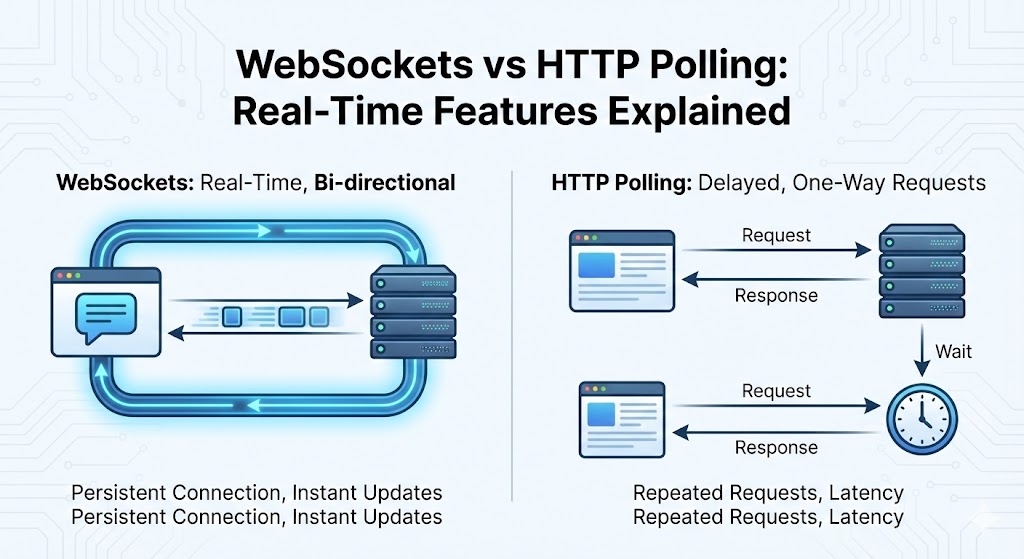
We have all been there. You are tracking a package, waiting for a secure login code, or having a text conversation, and you find yourself hitting the "Refresh" button over and over again.
In the modern web, users expect Real-Time functionality. When you send a message, it should appear instantly. When a stock price changes, the graph should tick immediately. To achieve this, developers generally choose between two architectures: HTTP Polling and WebSockets.
While the end result (live updates) looks the same to the user, the way the data travels behind the scenes is drastically different—and one is much more efficient than the other.
HTTP Polling: The "Are We There Yet?" Approach
The standard web runs on HTTP. The client (browser) sends a request, and the server sends a response. The server cannot speak unless spoken to.
To fake real-time updates, developers use Polling. The browser is programmed to send a request to the server every few seconds to ask, "Do you have new data for me?"
The Analogy
Imagine a child in the back seat of a car asking, "Are we there yet?" every 10 seconds. Child: "Any updates?" Driver: "No." Child (10s later): "Any updates?" Driver: "No." Child (10s later): "Any updates?" Driver: "Yes, here is a message."
The Downside: This creates massive "header overhead." If you have 1,000 users polling every 3 seconds, your server is handling 20,000 requests per minute, most of which return nothing. It wastes bandwidth and battery life.
WebSockets: The "Open Phone Line" Approach
WebSockets create a persistent, two-way connection between the browser and the server. Once the connection is established (the "handshake"), either side can send data at any time.
The Analogy
Imagine a telephone call. You dial the number once. The line stays open. When the driver has an update, they just say it. There is no need to ask repeatedly.
Comparison at a Glance
| Feature | HTTP Polling | WebSockets |
|---|---|---|
| Communication | Unidirectional (Client asks Server) | Bidirectional (Both talk freely) |
| Server Load | High (Many empty requests) | Low (Only sends when data exists) |
| Latency (Delay) | High (Depends on polling interval) | Low (Instant) |
| Ideal For | Slow-updating dashboards, Email | Chat apps, Live Sports, Gaming |
Real-Time in Django: Enter "Django Channels"
By default, Django is designed for the standard Request/Response cycle (WSGI). To handle WebSockets, we use a powerful extension called Django Channels (ASGI).
Django Channels allows your site to handle thousands of open WebSocket connections simultaneously without slowing down the rest of your website. It allows us to build features like:
- Live Notifications: Alerting a user the second someone likes their post.
- Collaborative Editing: Like Google Docs, where two users see each other's typing.
- Status Updates: Uber-style driver tracking.
Summary
If you are building a standard blog or e-commerce site, standard HTTP is fine. But if your business relies on instant communication or live data visualization, WebSockets are not just a luxury—they are a necessity for performance and scalability.