
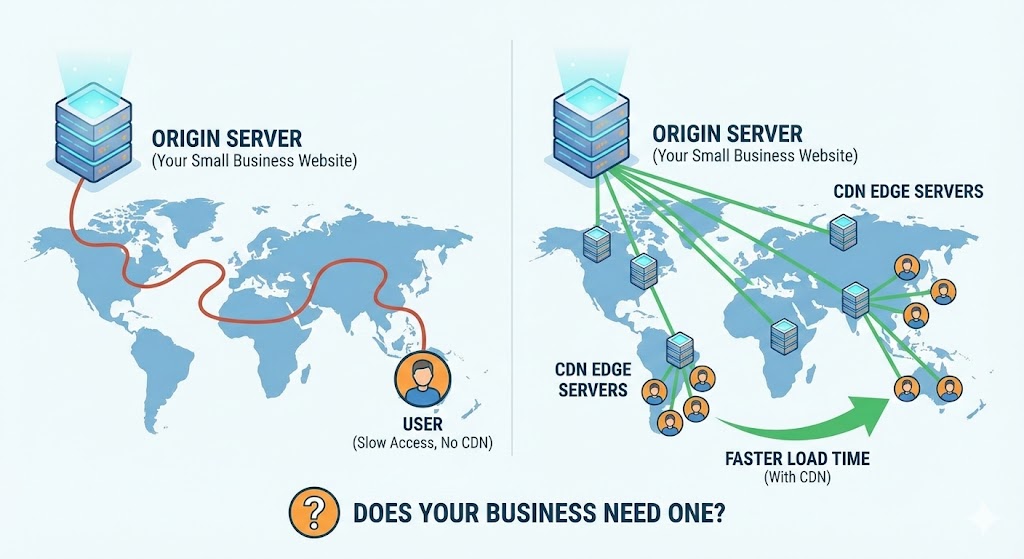
In the digital world, speed is the ultimate currency. If your website takes more than three seconds to load, 40% of users will abandon it. One of the most common acronyms thrown around to solve this speed problem is the CDN (Content Delivery Network).
But for a small business, technical jargon can often sound like an upsell. Is a CDN a necessary piece of infrastructure, or is it just enterprise-level overkill? To answer that, we first need to look at how the internet handles distance.
The Problem: The Speed of Light Limit
Imagine your website is hosted on a server in New York. When a customer in New York visits your site, the data travels a short distance. The site loads instantly.
Now, imagine a customer in Sydney, Australia visits your site. That data has to travel through fiber optic cables across the entire continental US and under the Pacific Ocean. Even moving at the speed of light, that distance creates a delay, known as latency.
The Solution: The Pizza Franchise Analogy
Think of your website like a famous pizza shop.
- Without a CDN: You have one kitchen in New York. If someone in Sydney orders a pizza, you have to bake it in New York and fly it to Sydney. By the time it arrives, it is cold (slow) and the delivery cost (bandwidth) is high.
- With a CDN: You keep your main recipe (your code) in New York, but you open "franchise" warming stations in London, Tokyo, and Sydney. When a customer in Sydney orders, the local Sydney station delivers the pizza. It arrives hot and fast.
Technically speaking, a CDN is a network of servers distributed globally. They store copies of your "static" assets—images, CSS files, and JavaScript—on servers closer to your users (called Edge Servers).
Does Your Small Business Actually Need One?
Not every website needs a CDN. Here is the checklist we use to advise our clients:
You Probably DON'T Need a CDN If:
- You are Hyper-Local: You are a dentist or a plumber serving a specific town. Your server is likely in the same region as your customers.
- Low Traffic: You have a brochure site with minimal images and fewer than 1,000 visitors a month.
- Development Stage: You are still building the MVP and don't need to optimize for milliseconds yet.
You DEFINITELY Need a CDN If:
- You Have a Global or National Audience: If you have customers on both the East and West coasts (or internationally), a CDN bridges the gap.
- You Are Image/Media Heavy: High-resolution product photos, portfolios, or video backgrounds eat up bandwidth. A CDN offloads this strain from your main server.
- You Worry About Crashing: If a viral post sends a spike of traffic to your site, a CDN absorbs the hit, keeping your main server alive.
- Security is a Priority: Many CDNs (like Cloudflare) act as a shield, sitting in front of your site to block malicious bots and DDoS attacks before they ever touch your database.
The Verdict
In 2025, CDNs have become incredibly affordable—many offer robust free tiers. Given the SEO benefits (Google loves fast sites) and the security perks, the barrier to entry is low.
For our Django clients, we almost always recommend integrating a CDN for serving static media. It separates your application logic from file delivery, resulting in a snappier, more professional experience for your users.