In the early days of the internet, a website was essentially a digital pamphlet. It had a homepage, an "About Us" section, and a phone number. For some businesses in London, this is still enough. If you run a small corner shop or a local café, you might only need to tell people where you are and when you are open.
But for many modern businesses, the "brochure" model is dead. We are moving into the era of the Web Application.
You interact with web apps every day without realising it. When you book an Uber, log into online banking, or use Gmail, you aren't just visiting a website; you are using a sophisticated piece of software that lives in your browser. At Custom Coded Websites, we find that many clients come to us asking for a "website" when what they actually need is a "web app." Understanding the difference is the key to unlocking massive efficiency and growth for your company.
What is the Difference? (Website vs. Web App)
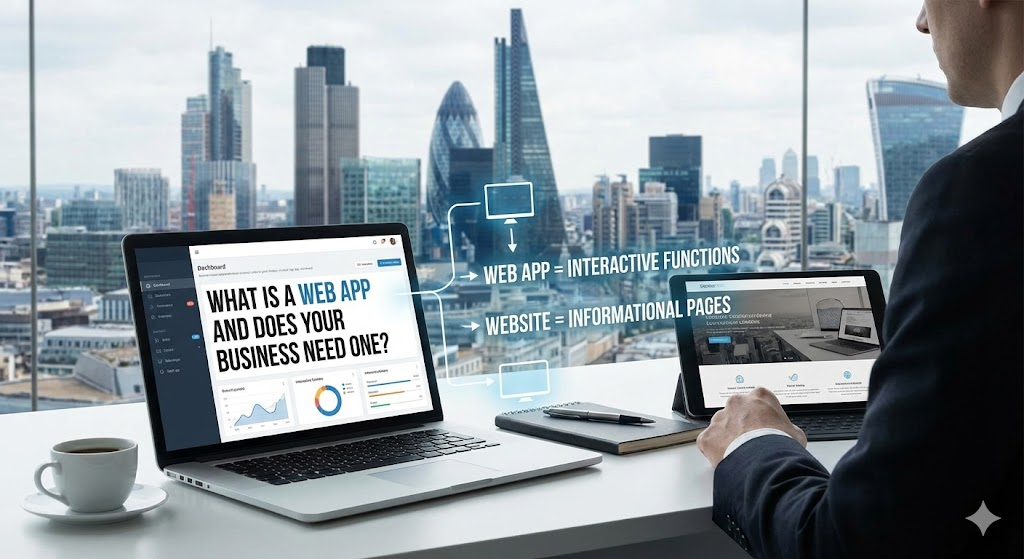
The line can sometimes be blurry, but the fundamental difference lies in interactivity and functionality.
The Website (Informational)
A website is primarily for consumption. Users come to read, watch, or look. The flow of information is one-way: from you to the visitor. Examples: A portfolio for a photographer, a restaurant menu, or a blog.
The Web App (Functional)
A web application is for interaction. Users come to do something. They input data, the system processes it, and it gives them a result. It allows users to manipulate data, perform tasks, and automate workflows. Examples: A client portal where users download invoices, a booking system for a hair salon, or the automated deed poll platform we built for UK Name Change.
Does Your Business Need a Web App?
If you are unsure whether you need a brochure site or a custom web application, ask yourself the following four questions. If you answer "Yes" to any of them, you are looking for an app.
1. Do you rely heavily on spreadsheets?
This is the most common trigger. We see many London businesses—from recruitment agencies in Shoreditch to logistics firms in Heathrow—running their entire operation on Excel. They manually email spreadsheets back and forth, leading to version control nightmares and data errors.
The Web App Solution: We can build a secure, central dashboard where your team logs in to input data. The system validates the data instantly, stores it securely in a database, and generates real-time reports. No more "Final_Version_V3.xlsx".
2. Do your customers need to "log in"?
If you need to provide a personalized experience, you need a web app. A standard website treats every visitor the same. A web app knows who the user is.
The Web App Solution: A client portal allows your customers to self-serve. They can log in to view the status of their order, download past invoices, update their details, or communicate with your team securely. This reduces the burden on your customer support lines significantly.
3. Do you sell a service that can be automated?
Many service businesses do things manually that could be done by code.
The Web App Solution: Take our client UK Name Change as an example. They provide deed polls. Previously, this might have involved a human typing out a document. We built a web app where the customer types their details, the system checks for errors, processes the payment via Stripe, and automatically generates the legal PDF. The "service" is now fully automated, allowing the business to run 24/7 with zero human intervention.
4. Do you need to access data from anywhere?
Traditional software often lives on a specific office computer. If you are out meeting a client in Westminster and need to check inventory, you are stuck.
The Web App Solution: Because web apps run in the browser, they work on any device with an internet connection. Your sales team can use an iPad to check stock levels in real-time while standing in a client’s office, or your project managers can update job statuses from their phone on the train home.
Why Custom Code (Python & Django) Matters
You cannot build a robust web application using a drag-and-drop builder like Wix. Those tools are for static display.
To build a web app, you need a powerful programming language. At Custom Coded Websites, we use Python and Django. This is the same technology stack used by Instagram, Spotify, and Pinterest. It offers:
- Security: Essential if you are handling user passwords and personal data.
- Scalability: It can handle ten users or ten million users.
- Flexibility: Because we write the code, we can build exactly the feature you need. If you want a button that sends an SMS to your delivery driver when an order is packed, we can build it.
The Progressive Web App (PWA) Advantage
One of the biggest trends in 2025 is the Progressive Web App. This is a website that looks and feels like a native mobile app. Users can add it to their home screen, and it can even work offline. However, unlike a native app, you don't have to convince users to download it from the App Store, and you don't have to pay Apple or Google a 30% cut.
For many small businesses, a PWA is the perfect middle ground: the accessibility of a website with the power of an app.
Conclusion
A website tells people who you are. A web app helps you run your business. In a high-cost environment like London, efficiency is everything. By automating manual processes and allowing clients to self-serve, a custom web application can reduce your overheads and increase your capacity to scale.
Are you ready to stop using spreadsheets and start using software?