
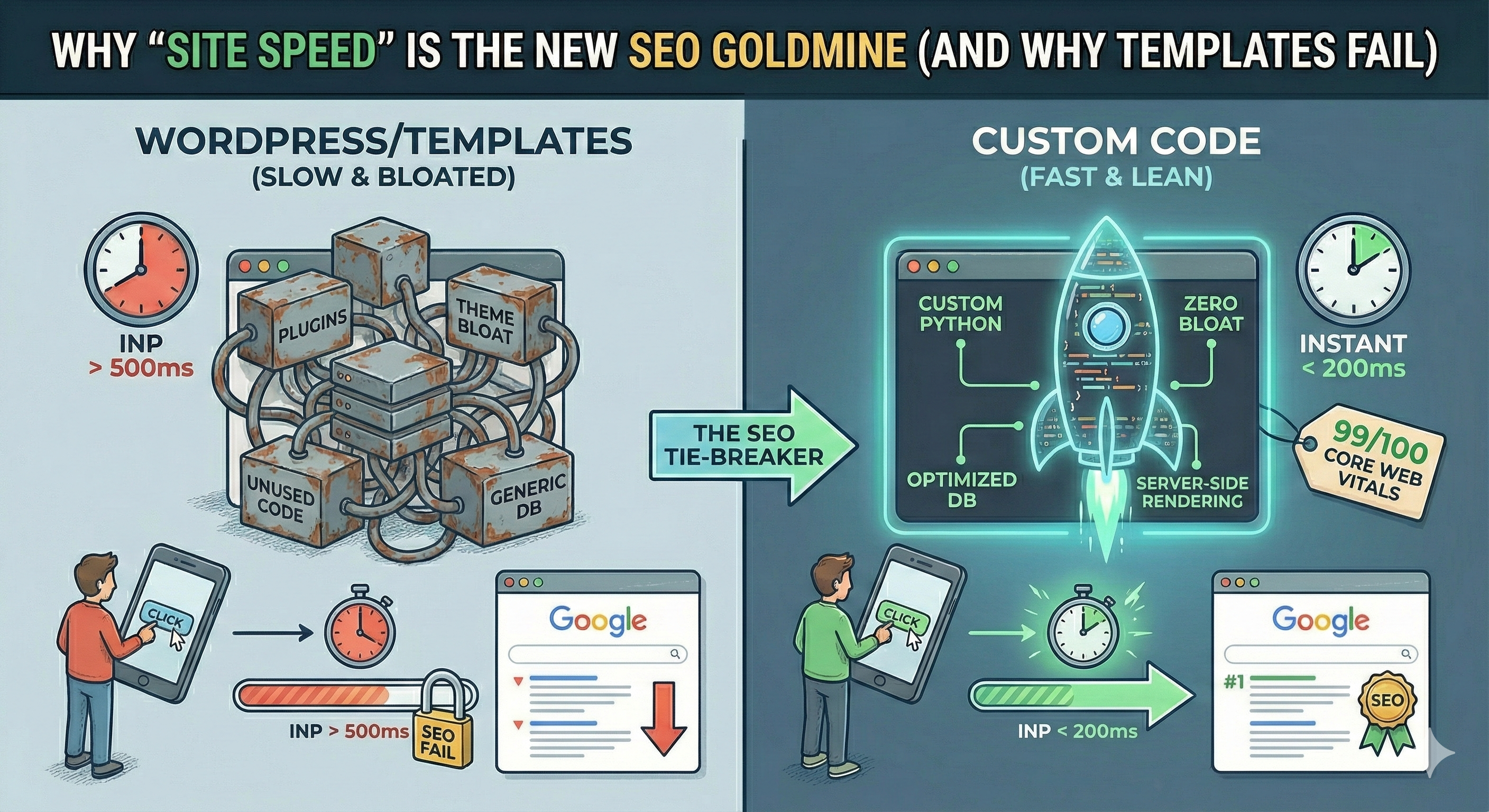
Why "Site Speed" is the New SEO Goldmine (And Why Templates Fail)
For years, "SEO" (Search Engine Optimization) was all about keywords. If you stuffed enough mentions of "plumber in Bristol" onto your page, you ranked.
In 2025, that game is over. Google’s AI algorithms are now smart enough to read content like a human. But there is one metric that has become the absolute tie-breaker for the #1 spot: Site Speed.
At Custom Coded Websites, we see clients moving to us from WordPress not just because they want a prettier site, but because they are tired of being invisible on Google. Here is why speed is your biggest untapped revenue source—and why template sites are physically incapable of unlocking it.
The "Core Web Vitals" Reality
Google doesn't just guess if your site is fast. It measures it using a strict set of metrics called Core Web Vitals.
If you fail these tests, Google effectively puts a "slow" label on your site and pushes you down the rankings. In 2025, the most critical metric is INP (Interaction to Next Paint).
- What is INP? It measures how quickly your site reacts when a user clicks a button.
- The Target: Google demands a response in under 200 milliseconds.
- The Reality: Most heavy WordPress sites take 500ms+ just to wake up the server.
The "Goldmine" Stats: Speed = Money
Why do we call speed a "goldmine"? Because the correlation between speed and revenue is undeniable.
Recent data is brutal for slow sites:
- Amazon found that every 100ms of latency cost them 1% in sales.
- Deloitte found that improving load times by just 0.1s boosted conversion rates by 8%.
- 53% of mobile users abandon a site if it takes longer than 3 seconds to load.
If your site loads in 4 seconds, you aren't just annoying users—you are actively burning money.
Why Templates (WordPress/Wix) Fail at Speed
You might ask: "Can't I just install a caching plugin on WordPress to make it fast?"
You can try, but you are fighting a losing battle against architecture. Here is why templates struggle to hit that "Green" 100/100 score on Google PageSpeed Insights.
1. The "Kitchen Sink" Problem
When you buy a £50 WordPress theme, it includes code for everything—sliders, portfolios, e-commerce, forums—just in case you might need it. Even if you don't use them, that code often still loads in the background.
2. Plugin Conflicts
To get functionality, you stack plugins. One plugin for SEO, one for forms, one for analytics. Each plugin adds its own JavaScript and CSS files. Before long, your user's browser is trying to download 50 different files just to show a homepage.
3. Database Drag
WordPress stores everything in a generic way. As your site grows, finding data becomes slower. A custom SQL database (which we build with Django) is structured specifically for your data, making retrieval instant.
The Custom Code Advantage
When we build a site at Custom Coded Websites, we code "Market-Leading Speed" as a standard feature, not an add-on.
- Zero Bloat: We write only the CSS and Python required for your features.
- Server-Side Rendering: We deliver the page ready-to-read from the server, meaning the user's phone doesn't have to do the heavy lifting.
- 99/100 Scores: We regularly achieve perfect "Green" scores on Google Core Web Vitals, giving you an immediate SEO advantage over competitors using clunky themes.
Stop Losing Traffic to Slow Code
If you are spending money on Google Ads or SEO but sending traffic to a slow website, you are wasting your budget.
Upgrade to a platform built for the speed of 2025.