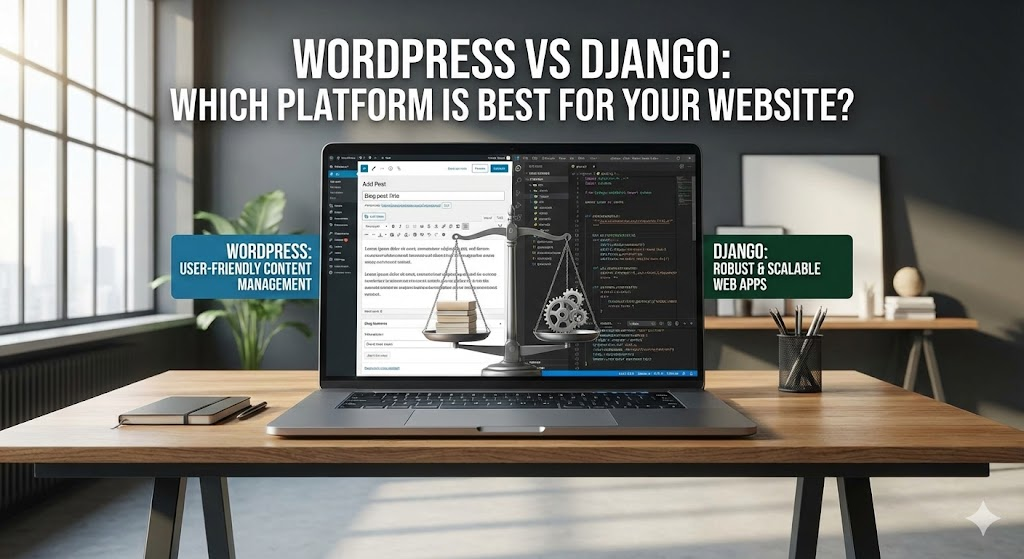
If you are planning a new website for your business, you have likely encountered a common debate: should you go with the popularity of WordPress or the robust power of a framework like Django? It is a question we hear often at our London agency.
WordPress is the giant of the internet, powering roughly 40% of all websites. It is famous for its ease of use and massive plugin library. On the other hand, Django is a high-level Python web framework designed for "perfectionists with deadlines." It powers some of the most traffic-intensive sites in existence, including Instagram, Pinterest, and Spotify.
So, which is right for you? At Custom Coded Websites, we believe the answer lies in your long-term goals. Let’s dive deep into the comparison between these two giants to see which architecture suits the competitive London market.
1. The Fundamental Difference: CMS vs. Framework
To understand the comparison, you must first understand what they are.
WordPress is a Content Management System (CMS). It comes ready-made out of the box. You install it, pick a theme, add some content, and you are live. It is designed primarily for blogging and basic business information.
Django is a web framework written in Python. It isn't a "website" out of the box; it is a set of tools that allows developers to build a website exactly to specifications. It doesn't force a structure on you; it allows you to build the structure you need.
2. Security: Locking Down Your Data
In an era where data breaches are front-page news, security is non-negotiable, especially for London’s financial and professional service sectors.
The WordPress Risk
WordPress's popularity is its biggest weakness. Because so many sites use it, it is the number one target for hackers. Most WordPress hacks happen not through the core software, but through third-party plugins and themes. If you install a plugin that hasn't been updated in six months, you may have just opened a backdoor to your server.
The Django Fortress
Django takes security seriously. It is often described as "secure by default." It has built-in protection against many common security threats, including:
- SQL Injection: Preventing attackers from injecting malicious code into your database.
- Cross-Site Scripting (XSS): Stopping attackers from running scripts in a user's browser.
- Clickjacking: Preventing users from being tricked into clicking something different from what they perceive.
For businesses handling sensitive customer data—like the deed poll applications we manage for UK Name Change—Django provides a level of trust that a standard CMS struggles to match.
3. Performance and "Code Bloat"
We have mentioned "code bloat" before, but it bears repeating. Google's Core Web Vitals assessment penalises slow websites.
WordPress: To make themes "multipurpose," developers pack them with features you will never use. A simple homepage might load scripts for a slider, a gallery, and a contact form, even if none are present. This extra weight slows down load times, frustrating users on mobile networks.
Django: With a custom Python build, we write only the code necessary for your specific features. The result is a lean, lightning-fast application. This speed advantage is a critical factor for SEO rankings, helping you stand out in local London search results.
4. Scalability: Thinking Big
Most businesses start small, but few intend to stay that way.
WordPress is excellent for small to medium-sized blogs or brochure sites. However, if you try to scale it into a massive e-commerce store or a social platform, the database structure can become a bottleneck. You often end up "hacking" the CMS to make it do things it wasn't designed for.
Django is built for scale. It follows a "shared-nothing" architecture, meaning you can add hardware at any level—database servers, caching servers, or web servers—to handle massive traffic spikes. This is why tech giants choose it. If your ambition is to grow from a local Shoreditch start-up to a global enterprise, Django ensures you won't need to rebuild your platform in two years.
5. Customisation and Flexibility
WordPress relies on plugins. need a booking calendar? There is a plugin for that. Need a forum? There is a plugin for that. But these plugins are generic. They might do 80% of what you want, but changing that last 20% to fit your unique business model can be a nightmare of conflicting code.
Django offers total freedom. Because we are coding from scratch, we can build logic that is 100% tailored to your workflow. Whether it is a complex pricing algorithm for an insurance quote or a unique inventory feed for a collectibles store like Anime Weebs, Python can handle complex logic with ease.
The Verdict: Which Should You Choose?
Choose WordPress if:
- You have a very limited budget.
- You need a simple blog or brochure site quickly.
- You do not require complex custom functionality or heavy data processing.
Choose Django (Custom Development) if:
- You are building a web application or a complex e-commerce platform.
- Security is a top priority (e.g., Fintech, Legal, Medical).
- You need a website that is extremely fast and SEO-optimised.
- You want a unique design and user experience that stands out from competitors.
- You plan to scale significantly in the future.
Conclusion
While WordPress is a fantastic tool for many, serious businesses often outgrow its capabilities. At Custom Coded Websites, we specialise in Python and Django because we believe in giving our clients the strongest possible foundation for their digital presence.
Don't let a generic template limit your potential. If you want a website that is as unique and ambitious as your business, it is time to look beyond the CMS.
Ready to build something powerful? Contact us today to discuss your custom Django project.