Custom E-commerce Website Development
Online shops you own outright, hand-coded in Django by a two-person UK studio. No monthly platform fees, and no platform taking a cut of every sale.
What you get
A shop built around your products and how you actually sell them.
Own it outright
No subscription creep, no app fees and no platform cut on top of card processing. Once the project is paid for, the shop, its code and its customer data are yours.
Checkout that converts
Stripe with Apple Pay and Google Pay, multi-currency support, and a checkout flow with no unnecessary steps.
Simple to run
Stock, orders, discounts and shipping managed from one clean dashboard built around how you work.
Products that fit
Variants, bundles, personalised or made-to-order items, trade price lists and pre-orders, modelled properly rather than bolted on with apps.
Found on Google
Fast pages, clean URLs, product structured data and an XML sitemap from launch day, so search engines understand every product.
Connected to your tools
Orders flow into the accounting, courier and email tools you already use through their APIs, instead of being typed in twice.
Is a custom shop right for you?
Shopify and similar platforms are a sensible way to start selling online. If you have a small catalogue and standard shipping, a platform will probably serve you well, and we will tell you so. A custom e-commerce website starts to pay off when:
- Platform costs keep climbing. Monthly plans, paid apps and transaction fees have become a real cost that grows with every order.
- Your products don't fit the template. Personalised or made-to-order items, bundles, trade pricing or subscriptions need a stack of apps to fake.
- You sell into more than one market. You want prices, currencies and shipping rules that behave properly for overseas customers.
- The shop is part of something bigger. Bookings, memberships or a trade portal need to share customers, stock and payments. That is where our custom platform and booking system work comes in.
The two shops below show how different that can look: themed cookie-cutter bundles sold worldwide through a multi-currency checkout, and limited-edition anime drops across more than 10,000 products.
Built and running
Not mock-ups - real businesses using this every day. Click through and try them.
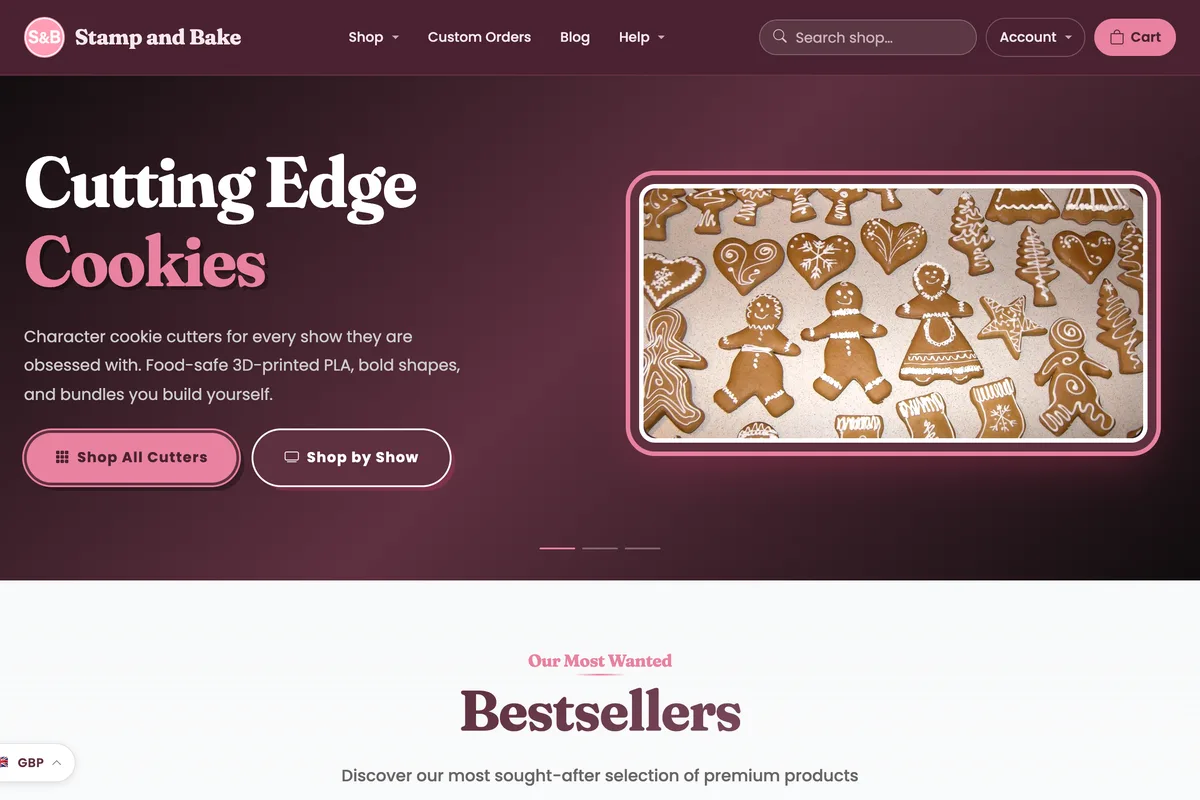 Stamp and Bake
Food-safe 3D-printed cookie cutters, selling worldwide.
Stamp and Bake
Food-safe 3D-printed cookie cutters, selling worldwide.
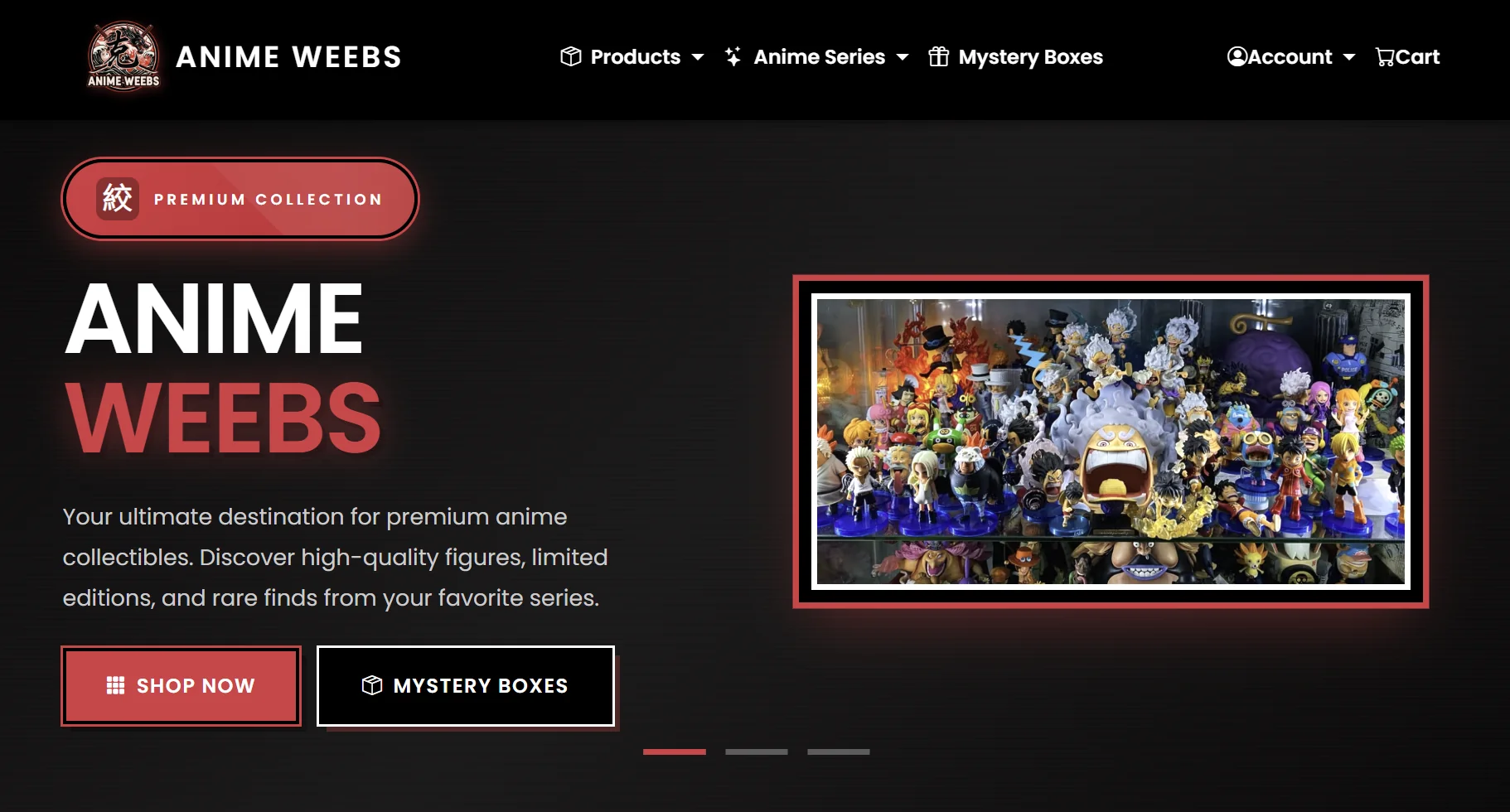 Anime Weebs
Premium anime collectibles and limited-edition drops.
Anime Weebs
Premium anime collectibles and limited-edition drops.
Our Stamp and Bake shop is exactly what we wanted - it looks the part, it's quick, and adding new cutters and bundles takes minutes. Checkout just works, customers order from overseas without any fuss, and sales have climbed steadily since we launched.
Anime Weebs moved onto the Django platform we built for it in 16 weeks, including a full data migration, with real-time stock that stops overselling during limited-edition drops. Read the Anime Weebs case study or browse our full portfolio.
Custom e-commerce vs Shopify
The honest trade-off: pay more up front, then stop renting.
| Shopify | Custom shop | |
|---|---|---|
| Up-front cost | Low: a theme, apps and setup | Higher: designed and built for you |
| Running costs | Monthly plan, paid apps and card fees, plus an extra fee per order if you don't use Shopify Payments | Card fees, hosting and maintenance, with no platform subscription |
| Time to launch | Days to a few weeks | Weeks to months, depending on scope |
| Checkout and pricing rules | Whatever the platform and its apps allow | Built around your rules |
| Code and data | You rent the platform, and your theme and apps stay behind if you leave | You own both, on open-source Django |
We work through the actual fees for an illustrative £250,000-a-year store, along with wholesale, migration and SEO, in Shopify vs custom e-commerce: costs, pros and cons.
How it works
Tell us what you need
A short call in plain English. We ask how you price, ship and fulfil orders, and what your current shop makes hard.
Fixed quote
A written scope with milestones: exactly what we'll build, what it costs, and how long it takes.
We build it
Hand-coded on a private staging site you can click through and comment on as it takes shape.
Launch & care
We migrate your products, redirect old URLs and go live with a 30-day bug-fix warranty, then keep it fast, secure and up to date.
Under the hood
The parts customers never see, and why we build them the way we do.
Django and PostgreSQL
Every shop is a Django application on a PostgreSQL database, the same stack behind UK Name Change. Django brings user accounts, an admin and protection against common web attacks, so your budget goes on what makes your shop different.
Stripe checkout, confirmed by webhook
Stripe covers cards, Apple Pay, Google Pay and multi-currency pricing, and card details never touch your server. Orders are confirmed by Stripe's webhook rather than by the customer's browser, so a shopper who closes the tab straight after paying still gets their order, and one payment can never create two orders.
Stock that can't oversell
When one item is left, two customers can reach the checkout at the same moment. We reserve stock inside a database transaction that locks the product row (Django's select_for_update()), so exactly one of them gets it and the other sees an honest "sold out" message instead of a refund email later. That matters most for limited drops, which is exactly what Anime Weebs sells.
Fast pages that Google understands
Pages are rendered on the server, images are compressed to modern formats such as WebP, and every product carries Product structured data so Google can show its price and availability. Our guide to product schema markup explains the JSON-LD in detail.
What does a custom shop cost?
Every shop gets a fixed quote after a free call, because the price depends on what it has to do. The things that move it most are:
- Catalogue: how many products and variants you sell, and whether they are personalised or made to order.
- Pricing rules: trade tiers, bundles, subscriptions, discount logic and multiple currencies.
- Integrations: accounting, stock, courier and email systems, and how much data moves between them.
- Migration: bringing products, customers and order history across from an existing shop, with redirects.
As a guide, our published starting points are £5,000 to £15,000 for a moderate web application and £15,000 and up for complex systems. A shop with its own checkout, stock control and admin is a web application, so where yours lands depends on the list above. After launch there is no platform subscription, and our website maintenance plans cover hosting, backups and updates.
Still at the planning stage? Our guide on how to plan a custom e-commerce website covers VAT, payments, shipping and what to prepare before you ask anyone for a quote.
Common questions
Why not just use Shopify?
Shopify is quick to start and suits plenty of small shops. But you rent it for as long as you trade: a monthly plan, paid apps and, unless you use Shopify Payments, an extra fee on every order. A custom shop costs more up front, then has no platform fees, and does exactly what your products need.
Can it take international orders?
Yes. Multi-currency pricing, international shipping rules and tax handling are all built in where you need them.
Can you move my existing shop over?
Yes. We migrate products, customers and order history, and set up 301 redirects from your old URLs so the search rankings you have already earned carry over to the new shop.
How long does a custom e-commerce website take to build?
It depends on scope, and you get the timeline in writing with your fixed quote. As a guide, a moderate web application takes 4 to 8 weeks and a complex platform 3 to 6 months. The Anime Weebs re-platform, including a full data migration, took 16 weeks.
Is a custom shop secure for taking payments?
Yes. Card details are entered into Stripe's secure payment fields and never touch your server, which keeps PCI compliance simple. The site runs over HTTPS, and a maintenance plan keeps it patched and backed up.
Will I own the code and the customer data?
Yes. Once the project is paid for, you own the code we write for you and all of your data. The shop runs on open-source Django and PostgreSQL, so any Python developer can work on it if you ever move on.
Are there any ongoing fees?
There is no platform subscription and no platform cut of your sales. You pay Stripe's standard card processing fees and, if you want us to host and look after the shop, a monthly maintenance plan.
Ready to own your shop outright?
Tell us what your business needs - we'll tell you exactly what we'd build, what it would cost, and how long it would take.